
 English EN
 French FR
 German DE
 Portuguese PT
 Spanish ES
 Russian RU
 Japanese JA
 Korean KO
 Arabic AR
 Greek EL
 Turkish TR
 Italian IT
 Polish PL
 Hindi HI
 中国 CN
中国 CN
.webp)
Join Saillage at Impressions Expo Long Beach 2026 – Visit Us at Booth 681!
We are thrilled to announce that Saillage will be ...
MoreAnswering the question "Can you use sublimation ink on dtf film?" is not a simple yes or no. The practice exists, but it operates as a "hack" with significant limitations. This method is not true Direct-to-Film (DTF) printing; it does not yield the same professional-grade results. The process leverages DTF powder to transfer sublimation ink onto fabrics it normally cannot bond with, such as cotton. However, this technique is only effective for light-colored fabrics and offers lower durability compared to both standard sublimation and true DTF printing.
Understanding why this "hack" has limitations requires a look at the fundamental chemistry of each ink type. Sublimation ink and DTF pigment ink are engineered for entirely different processes. Their core components and binding mechanisms are not interchangeable, leading to a significant drop in quality when they are mixed and matched.
Sublimation ink is a dye-based ink with a unique property. The ink's composition includes solid dye colorants suspended in a liquid carrier, which can be either water-based or solvent-based. Its magic happens under specific conditions.
When heated to temperatures between 375–400°F (190–205°C), this ink bypasses the liquid state and converts directly into a gas. This process, known as sublimation, allows the gaseous dye to penetrate and bond with polyester fibers at a molecular level. The dye becomes an integral part of the fabric itself.
Key Takeaway: Sublimation ink does not simply sit on a surface. It chemically fuses with polyester, resulting in a print with no texture and exceptional durability on the correct material. It has no natural ability to bond with cotton or other non-polymer materials.
True DTF printing uses a specialized pigment-based ink. Unlike sublimation dyes, these pigments have no inherent ability to bond with textile fibers. Instead, they rely on chemical engineering to work. DTF ink contains several key components:
Resins: These polymers help the ink adhere to the transfer film and later to the fabric.
Additives: These agents improve ink flow, control drying time, and enhance adhesion.
The process is mechanical, not chemical. The ink is printed onto a dtf film, coated with an adhesive powder, and then heat-pressed onto the garment. The ink, powder, and resin melt together to form a durable, flexible layer that sits on top of the fabric. This is why true DTF works on cotton, polyester, darks, and lights—it creates its own surface rather than dyeing the fibers.
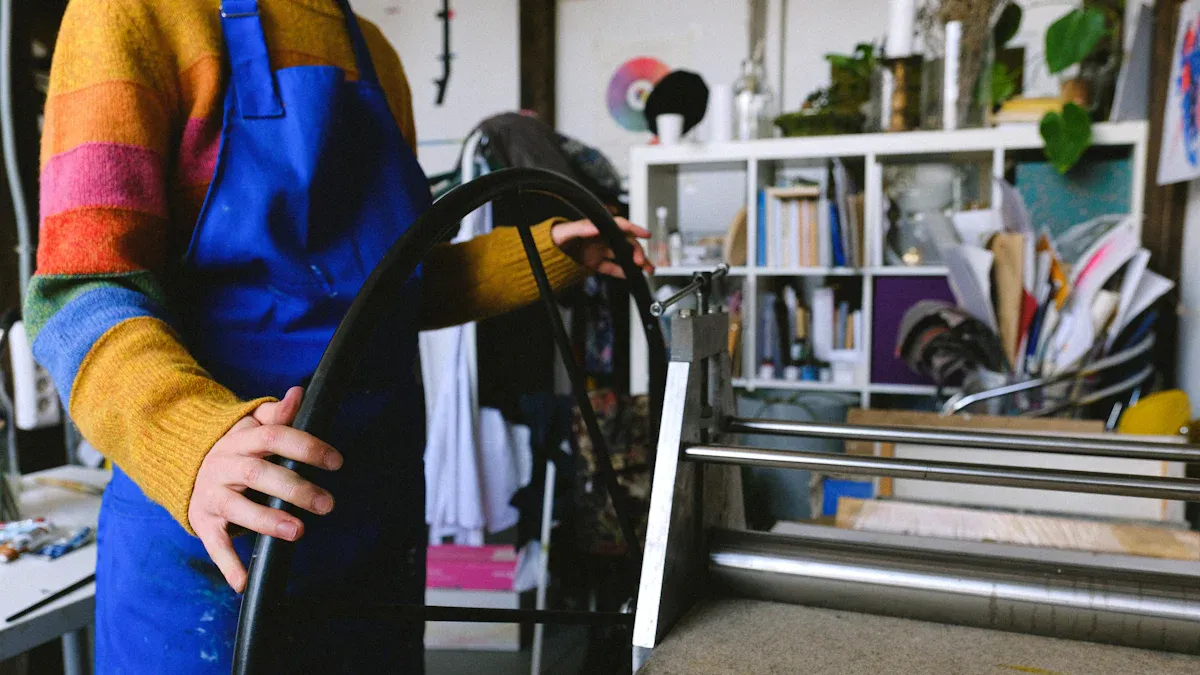
This process combines elements from both sublimation and DTF printing. It requires careful execution at each stage to achieve a usable, albeit limited, result. The following steps outline how to create a transfer using sublimation ink on DTF materials.
The first step involves printing the design. A user loads a sheet of dtf film into their sublimation printer. The printer must print on the matte or coated side of the film, not the glossy side.
For printer settings, one should select "photo paper glossy" or "normal" quality. This choice is critical. Higher quality settings deposit too much ink, which can cause oversaturation and bleeding on the film's surface. The goal is a clean print that holds its shape without excessive ink pooling. Remember to mirror the image before printing, just as with standard sublimation.
After printing, the design needs an adhesive layer. The user generously applies DTF adhesive powder over the wet sublimation ink. It is essential to cover the entire printed area completely.
The user then gently shakes the film to distribute the powder evenly. Tilting the sheet back and forth ensures every part of the design receives a uniform coating. Once covered, the user can tap the back of the film to shake off any excess powder. The powder will only stick to the inked portions of the design.
Pro Tip: Perform this step in a tray or container to catch the excess powder. This practice minimizes mess and allows for the reuse of the leftover adhesive.
Curing melts the powder, creating the adhesive layer that will bond to the fabric. A user can cure the powder with a heat press or a curing oven. The heat source should hover over the film without making direct contact.
The process requires a temperature between 300-350°F (149-177°C). Curing time can range from 10 seconds to 90 seconds, depending on the equipment and powder. The powder is fully cured when it transforms from a grainy texture to a glossy, orange-peel-like finish.
Once cured, the transfer is ready to press onto the garment.
| Stage | Temperature (°F) | Time (seconds) | Pressure |
|---|---|---|---|
| Powder Curing | 300-315 | 10-13 | Hover (No Contact) |
| Fabric Pre-press | 300-315 | 3-5 | Medium |
| Final Transfer | 300-315 | 15-20 | Medium |
The user pre-presses the fabric to remove moisture, then places the transfer and presses it with medium pressure. After pressing, the transfer should be a cold peel, meaning the user waits for it to cool completely before removing the film.
While the "Subli-DTF" hack offers a creative way to print on cotton, its results are far from perfect. A user must understand three critical limitations before attempting this method. These drawbacks involve fabric color, image quality, and long-term durability. Ignoring them can lead to wasted materials and disappointing outcomes.
The most significant limitation is the inability to print on dark-colored garments. This issue stems from the fundamental nature of sublimation ink. Standard sublimation printers operate on a CMYK (Cyan, Magenta, Yellow, Black) color model and do not contain white ink. Sublimation inks are translucent dyes, designed to color white or light-colored polyester fibers from within. They do not have the dense pigments needed to create an opaque layer that can block out the color of the fabric underneath.
Because sublimation ink inherently lacks white pigment, it cannot produce any white elements in a design. When a transfer made with this hack is pressed onto a black, navy, or dark-colored shirt, the garment's color shows through the translucent ink. This effect renders the design nearly invisible or severely discolored.
The Bottom Line: This hack is strictly for white or very light-colored fabrics (like pastels). Any attempt to use it on dark apparel will result in failure, as there is no white ink to create an opaque base layer.
Even on appropriate light-colored fabrics, the final print will lack the "pop" and vibrancy of true sublimation or DTF. The colors often appear muted or duller than they do on the computer screen. Several factors contribute to this reduction in quality.
The sublimation process relies on the ink turning into a gas and bonding with polyester. When using a dtf film, this chemical reaction does not happen. The ink is simply trapped in the melted adhesive powder. This incomplete process leads to less brilliant colors. Other technical issues also play a part:
Incorrect ICC Profiles: Color profiles (ICC) are essential for matching the colors from the screen to the printer. Since this is a "hack," there are no official ICC profiles. Users are left to guess, often resulting in inaccurate color reproduction.
Improper Heat Settings: If the heat press temperature is too low or the time is too short, the ink may not transfer fully from the film to the powder, causing a faded look. Too much heat can scorch the ink and distort the colors.
Ink Quality: Low-quality sublimation inks will produce less vibrant results in any application, and this weakness is magnified in the hack process.
A print's value is measured not just by its initial appearance but by how well it holds up over time. This is where the "Subli-DTF" hack shows its greatest weakness. The resulting transfers have significantly lower wash durability compared to their professional counterparts.
The bond created is purely mechanical and not chemically robust. The sublimation dye is not designed to fuse with the DTF adhesive powder. Instead, the powder essentially "glues" the un-sublimated ink onto the fabric's surface. This superficial bond breaks down quickly with washing and stretching. Users can expect to see cracking, peeling, and significant color fading after only a few laundry cycles.
| Printing Method | Bonding Mechanism | Resulting Durability |
|---|---|---|
| True Sublimation | Ink becomes a gas and fuses into polyester fibers. | Excellent; permanent bond. |
| True DTF | Pigment ink and adhesive melt to form a durable, flexible layer on top of the fabric. | Very Good; designed for washing. |
| Subli-DTF Hack | Adhesive powder traps sublimation ink on top of the fabric. | Poor; weak bond prone to cracking and fading. |
For hobby projects or single-use items, this may be acceptable. However, for any product intended for sale or long-term use, this low durability makes the method unsuitable.
Choosing the right printing method requires a clear understanding of what each process can deliver. The Subli-DTF hack, true DTF, and standard sublimation each have distinct advantages and disadvantages. A direct comparison of their capabilities in fabric choice, durability, and visual output will help a user select the appropriate technique for their specific project.
The type of fabric a user wants to print on is the most important factor. Each method interacts with materials differently, making this the first and most critical decision point. True DTF offers the greatest versatility, while sublimation is highly specialized. The hack attempts to bridge the gap but with major restrictions.
| Printing Method | Compatible Fabrics | Key Limitations |
|---|---|---|
| True DTF | Cotton, Polyester, 50/50 Blends, Tri-Blends, Nylon, Leather | Works on virtually any fabric, including dark and light colors. |
| True Sublimation | 100% Polyester (or high-poly blends), Polymer-Coated Hard Goods | Will not bond with natural fibers like cotton. Limited to white or light-colored substrates. |
| Subli-DTF Hack | Cotton, Cotton/Poly Blends | Strictly for white or very light-colored fabrics only. Does not work on darks. |
The Takeaway: True DTF is the universal solution for fabric choice. Sublimation is the specialist for polyester. The hack is a niche workaround for putting sublimation-style prints onto light-colored cotton, a task neither of the other methods can perform in the same way.
A print's longevity and how it feels on the garment—its "hand"—are crucial for quality. Here, the differences between the three methods are stark. The chemical bond of sublimation provides unmatched durability, while the mechanical bond of the hack is its weakest point.
True Sublimation: This method offers the highest durability. The ink becomes part of the polyester fibers, so the print will not crack, peel, or fade. It lasts as long as the garment itself. The feel is perfect, with zero texture, because the ink is infused into the fabric, not sitting on top of it.
True DTF: This process creates a highly durable print designed to withstand dozens of washes. The ink and adhesive form a strong, flexible layer on the fabric. The feel is a soft, smooth layer on the shirt, often described as thinner and more flexible than older heat transfer vinyl.
Subli-DTF Hack: This method produces the least durable result. The adhesive powder merely traps the sublimation ink against the fabric. This weak bond is prone to cracking and fading quickly, sometimes after only a few washes. The feel is often thicker and more plastic-like than a true DTF transfer because the ink and adhesive are not engineered to fuse together seamlessly.
For any item intended for resale or long-term use, the low durability of the hack makes it a poor professional choice.
The visual impact of a print is often what matters most. Color vibrancy and accuracy vary significantly across these techniques, driven by ink chemistry, the presence of a white base, and proper color management.
🎨 True Sublimation (on Polyester): This method produces the most vibrant, photorealistic colors possible. When the dye turns to gas, it creates continuous tones that are exceptionally brilliant on a white polyester surface. The colors are unmatched in their brightness and depth.
🎨 True DTF: This technique delivers excellent, punchy colors on any fabric color. The magic is its white ink underbase. This opaque white layer is printed first under the colors, preventing the shirt's color from affecting the design. This makes colors appear bright and accurate even on a black shirt.
🎨 Subli-DTF Hack: This process yields the dullest and least accurate colors of the three. The vibrancy is noticeably lower for several reasons:
No Chemical Reaction: The sublimation ink never turns into a gas and bonds with fibers. It is simply glued to the surface, resulting in a less brilliant appearance.
No White Ink: Like standard sublimation, the hack cannot produce white. On light fabrics, the colors lack the opaque base that makes true DTF prints pop.
No ICC Profiles: There are no official color profiles for this workaround. A user is printing sublimation ink onto a dtf film, a combination that printers are not calibrated for. This leads to unpredictable and often muted color output.
The financial investment and required equipment vary dramatically between these three methods. A user's budget and production goals will heavily influence their choice. The Subli-DTF hack presents a low-cost entry for existing sublimation users, while a true DTF system represents a significant professional investment.
💰 True Sublimation: This method offers the lowest barrier to entry for starting a printing hobby or small business.
Printer: A user can convert an entry-level inkjet printer, like an Epson EcoTank, for sublimation use. This is a very popular and cost-effective starting point.
Ink: A set of sublimation ink bottles is required to fill the printer.
Paper: Specialized sublimation paper is necessary for the ink transfer.
Heat Press: A quality heat press is essential for both sublimation and the other methods. The total startup cost for a basic sublimation setup can be relatively low, often falling in the range of $500 to $800 for a hobbyist-grade system.
💰 Subli-DTF Hack: This method is not a standalone process. It is an add-on for someone who already owns a sublimation setup.
Existing Equipment: A user must already have a sublimation printer, sublimation ink, and a heat press.
Additional Supplies: The only extra purchases are DTF film and DTF adhesive powder. The cost to try this hack is minimal for a current sublimation user, typically under $50 for the film and powder. It leverages an existing investment to expand capabilities in a limited way.
💰 True DTF: This is a professional-grade system with a much higher initial cost. The equipment is specialized and built for commercial production.
Printer: A dedicated DTF printer is required. These machines are engineered to handle viscous DTF pigment inks, including white ink, and often include features like ink circulation systems to prevent clogging.
Ink: A full set of DTF pigment inks (CMYK+White) is needed. White ink is a critical and costly component.
Shaker/Dryer: While not mandatory for small-scale operations, most professional setups include an automated powder shaker and curing oven. This machine applies powder and cures the transfers efficiently.
Software: Specialized RIP (Raster Image Processing) software is often necessary to manage color profiles and control the white ink layer. A complete, professional DTF system represents a substantial investment, with costs starting around $3,000 and easily exceeding $15,000 for larger, automated setups.
Cost Breakdown Summary: The table below provides a clear overview of the equipment needs and associated cost levels. It highlights the significant financial gap between a hobbyist setup and a professional DTF system.
| Item | True Sublimation | Subli-DTF Hack | True DTF |
|---|---|---|---|
| Printer | Sublimation Printer | Uses existing Sublimation Printer | Dedicated DTF Printer |
| Ink | Sublimation Ink (CMYK) | Uses existing Sublimation Ink | DTF Pigment Ink (CMYK+W) |
| Transfer Medium | Sublimation Paper | DTF Film | DTF Film |
| Adhesive | Not Required | DTF Powder | DTF Powder |
| Software | Basic Design Software | Basic Design Software | RIP Software (Often Required) |
| Initial Cost | Low ($500+) | Very Low (Add-on cost) | High ($3,000+) |
The "Subli-DTF" method has a very specific and limited use case. A user must weigh the benefits of experimentation against the significant drawbacks in quality and durability. The decision to use this hack depends entirely on the user's goals, whether they are a hobbyist exploring new techniques or a professional building a business.
For a hobbyist who already owns a sublimation printer, this hack is an excellent, low-cost way to experiment. It opens the door to printing on light-colored cotton items, a material normally off-limits to sublimation. This method allows for creative exploration without the substantial financial commitment of a full DTF system. Some home-based businesses have even found success with it for small-scale projects.
One home apparel business used the hack with their existing sublimation printer.
This allowed them to add cotton T-shirts to their product line.
The business saw a 30% increase in sales over a three-month period.
However, hobbyists must be prepared for challenges. Success requires patience and a willingness to test materials. Key limitations include:
Limited to Light Fabrics: The hack does not work on dark garments because sublimation ink is translucent and lacks a white ink base.
Transfer Durability Concerns: The bond is weaker than true DTF, leading to a shorter lifespan for the print.
Heat Setting Experimentation: A user must perform trial-and-error tests to find the right temperature and time to avoid ink bleeding and ensure a good transfer.
Professionals and commercial printers should avoid this hack for products intended for sale. The method's inconsistencies and poor durability present a significant risk to a business's reputation. Customers expect high-quality, long-lasting prints that can withstand regular washing. The Subli-DTF hack cannot reliably deliver on that promise.
Professional Standard: For any commercial application, product quality and customer satisfaction are paramount. A print that cracks, fades, or peels after a few washes reflects poorly on the seller and can lead to negative reviews and lost business.
The lack of a white ink layer also severely limits product offerings to only light-colored apparel. This restriction is not viable for a professional print shop that needs to service a wide range of customer demands. For reliable, vibrant, and durable prints on cotton, polyester, darks, and lights, investing in a true DTF system is the only professional choice.
The "Subli-DTF" method is a creative workaround, not a professional printing solution. Industry experts confirm that sublimation and DTF inks have distinct chemical compositions and should never be interchanged. While this hack allows sublimation users to experiment on light-colored cotton, the results suffer from poor wash durability and reduced color vibrancy.
Final RecommendationFor reliable, high-quality results on both light and dark fabrics, investing in a true DTF system is essential. The dedicated DTF printer market's significant growth, holding a 45.0% share in 2024, underscores its position as the industry standard for professional apparel printing.
No, a user cannot use a standard office printer. This process requires a printer already converted for and filled with sublimation ink. A regular inkjet printer with standard ink will not work for this method or for any sublimation process.
The primary benefit is allowing someone with a sublimation setup to print on light-colored cotton fabrics. It provides a low-cost way to experiment with cotton garments without buying a full DTF system.
No, the colors will appear duller. The ink does not undergo the proper chemical sublimation process. It is simply trapped by the adhesive. This results in significantly less vibrant and accurate colors compared to true sublimation on polyester.
The print has poor wash durability. Users should expect noticeable fading, cracking, or peeling after only a few laundry cycles. The mechanical bond is weak and not designed for longevity, making it unsuitable for commercial products.



Select the most popular foreign trade service products to meet your diverse needs
Select the most popular foreign trade service products to meet your diverse needs

Tel: +86 17706217416
Add: Building L2A, No. 520, Lane 1588, Zhuguang Road, Hongqiao World Center, Qingpu District, Shanghai, China






User Comments
Service Experience Sharing from Real Customers
James Wilson
Print Shop OwnerI was skeptical at first, but this DTF film works perfectly for my sublimation projects on polyester blends. The color transfer is vibrant and the fabric feels great. A fantastic alternative for specific applications!
Sarah Chen
Custom Apparel DesignerGreat product for expanding my service options! Using this DTF film for sublimation allows me to offer more durable prints on certain materials compared to traditional sublimation paper. It does require some press setting adjustments, but results are worth it.
Michael Rodriguez
Production ManagerThis has been a game-changer for our team. We primarily use it for sublimating onto hard surfaces like mugs and phone cases with a polyester coating. The DTF film releases the ink completely, giving us sharper details and no ghosting. Highly recommended.
Emily Foster
Craft Business OwnerYes, you can use it for sublimation, and it works wonderfully! I use it to create vibrant tote bags and hats. It's more forgiving than regular paper on my small press. The colors pop, and the process is straightforward once you get the hang of it.