
 English EN
 French FR
 German DE
 Portuguese PT
 Spanish ES
 Russian RU
 Japanese JA
 Korean KO
 Arabic AR
 Greek EL
 Turkish TR
 Italian IT
 Polish PL
 Hindi HI
 中国 CN
中国 CN
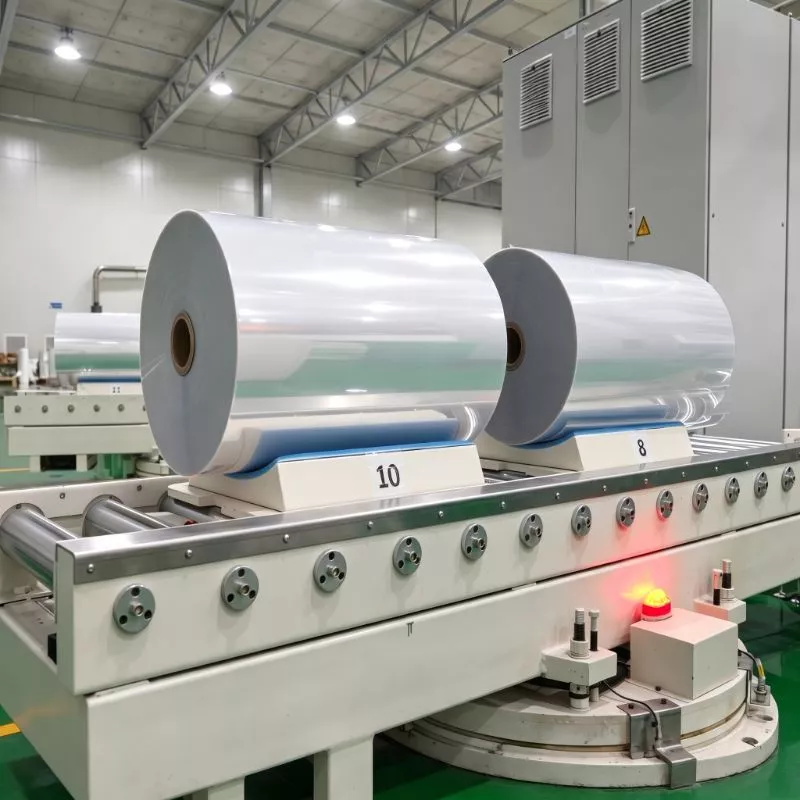
.webp)
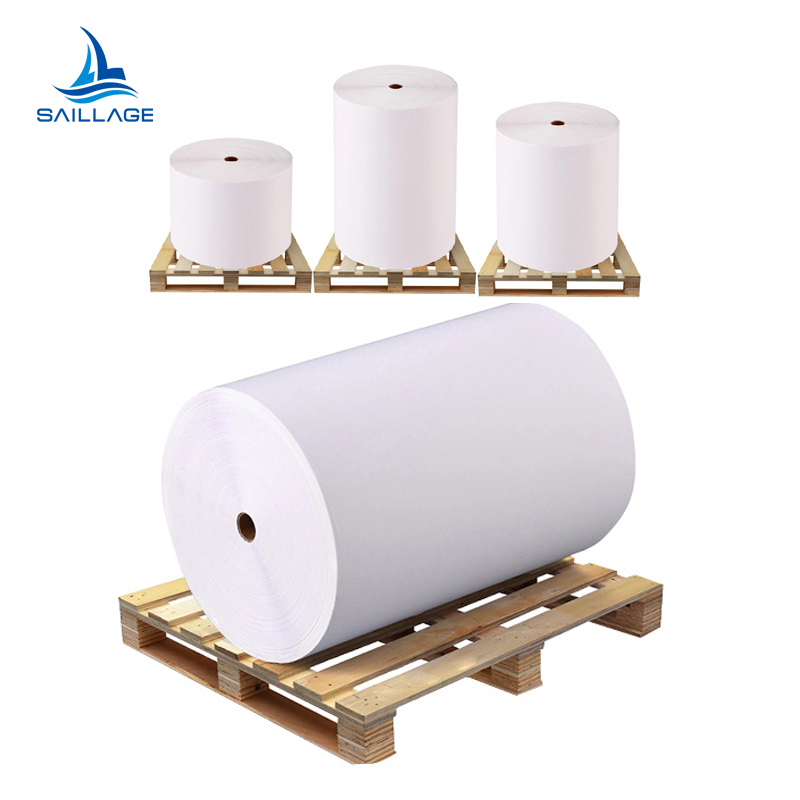
Why Density Matters for Pearlized BOPP Labels: Label Yield, Cost per Square Metre and Float-Sink Recyclability
Introduction: The Hidden Variable That Shapes Label Economics
For label converters and brand owners, the selection of pearlized BOPP label films typically focuses on aesthetics—opacity, whiteness, and that distinctive pearlescent sheen. Yet beneath the surface lies a critical technical parameter that silently drives material economics, production efficiency, and end-of-life recyclability: pearlized BOPP density.
Unlike plain BOPP films with a consistent density of approximately 0.91 g/cm³, pearlized BOPP films incorporate cavitation—microscopic voids created during the orientation process—to achieve their signature white, opaque appearance. This cavitation reduces density to a range of 0.55 to 0.80 g/cm³, depending on the specific grade and masterbatch formulation. This seemingly narrow density range has profound implications for three interconnected metrics: label yield (square metres per kilogram), cost per square metre, and float-sink recyclability in polypropylene recycling streams.
For procurement managers and technical decision-makers evaluating BOPP pearlized film suppliers, understanding the density-yield-recyclability relationship is essential. A lower-density film delivers more square metres per kilogram—potentially reducing material cost—but may compromise stiffness, machinability, or compatibility with recycling infrastructure. This article provides a technical framework for evaluating pearlized BOPP density as a strategic specification rather than a passive material property.
Key Takeaways
Pearlized BOPP density ranges from 0.55–0.80 g/cm³; lower density means higher yield (more m²/kg) and lower cost per square metre, but may affect stiffness.
The density threshold of < 1.0 g/cm³ is critical for float-sink separation in PP recycling—all pearlized BOPP films are intrinsically recyclable via this mechanism.
Yield differences between density variants directly impact material budgets; a 0.65 g/cm³ film delivers approximately 40% more yield than a 0.91 g/cm³ plain BOPP film.
Optimal density selection balances application-specific stiffness requirements against commercial and sustainability objectives.
1. The Material Science of Pearlized BOPP: Cavitation and Density Engineering
Pearlized BOPP is a coextruded, biaxially oriented polypropylene film engineered with a cavitated core layer. The manufacturing process incorporates specific masterbatches—typically based on calcium carbonate or incompatible polymers—that, during orientation, create micro-voids within the film structure. These voids scatter light, producing the characteristic white, opaque, pearlescent appearance without requiring titanium dioxide pigmentation.
The density of pearlized BOPP label films is a direct function of void volume fraction. A higher void fraction yields lower density but also reduces mechanical properties such as stiffness and tensile strength. Manufacturers therefore tailor density to specific applications: pearlized BOPP grades for wrap-around beverage labels typically range from 0.65–0.70 g/cm³, while grades requiring greater stiffness for in-mould labels or heavy-duty packaging may approach 0.80 g/cm³.
Critical technical relationships:
Density (ρ) ∝ 1 / Yield (m²/kg): Lower density directly increases yield—a film at 0.66 g/cm³ delivers approximately 39.9 m²/kg at 38 microns, while a 0.80 g/cm³ grade yields approximately 30.4 m²/kg at the same thickness.
Optical properties: Lower density (higher void fraction) increases opacity and whiteness but may reduce gloss. Pearlized BOPP grades with density around 0.66 g/cm³ typically achieve gloss values of 70–75% at 45°.
Mechanical trade-offs: Tensile strength and elastic modulus decrease with density. Typical pearlized BOPP density of 0.66 g/cm³ exhibits MD tensile strength of approximately 700 kg/cm², compared to 1,200+ kg/cm² for plain BOPP.
2. Application Scenarios: Density-Driven Decisions Across the Value Chain
The economic and operational impact of pearlized BOPP density varies across different supply chain roles. The following scenarios illustrate how density selection affects procurement, converting, and end-of-life outcomes.
2.1 Scenario 1: Procurement – Yield and Cost per Square Metre
For purchasing managers, the density specification directly translates to material yield—square metres of label stock per kilogram purchased. This relationship is non-negotiable: a 38-micron pearlized BOPP film with density of 0.66 g/cm³ yields approximately 39.9 m²/kg, while the same thickness film at 0.80 g/cm³ yields just 30.4 m²/kg.
Commercial impact: At a film price of $2.50/kg, the cost per square metre for the 0.66 g/cm³ grade is approximately $0.063, compared to $0.082 for the 0.80 g/cm³ grade—a 23% cost disadvantage for the higher-density film, assuming identical price per kilogram. This differential compounds across annual consumption volumes.
However, lower-density pearlized BOPP label films may require higher additive loading to maintain stiffness and machinability, potentially increasing unit cost. The procurement decision must therefore balance direct material cost against performance requirements.
2.2 Scenario 2: Converting – Stiffness and High-Speed Machinability
For label converters, pearlized BOPP density affects machinability on high-speed wrap-around labeling equipment. Films with density below 0.60 g/cm³ may exhibit reduced stiffness, leading to:
Edge curl during die-cutting
Difficulty in high-speed dispensing (above 300 bottles/minute)
Registration errors on rotary presses
Industry practice suggests that pearlized BOPP grades for demanding wrap-around label applications typically operate at 0.65–0.72 g/cm³, providing sufficient stiffness for high-speed converting while maintaining yield advantages over plain BOPP.
2.3 Scenario 3: Sustainability – Float-Sink Recyclability
The environmental case for pearlized BOPP is compelling: all pearlized BOPP density variants (0.55–0.80 g/cm³) are less dense than water (1.0 g/cm³), enabling clean separation from heavier contaminants in PP recycling streams. In float-sink separation tanks, pearlized BOPP label films float and are recovered as clean PP flakes, while PET, PVC, and other contaminants sink.
This contrasts with plain BOPP (0.91 g/cm³), which also floats but may be mixed with other polyolefins. The pearlized BOPP structure itself does not impede recycling—the voids collapse during extrusion, producing high-quality recyclate for non-food applications.
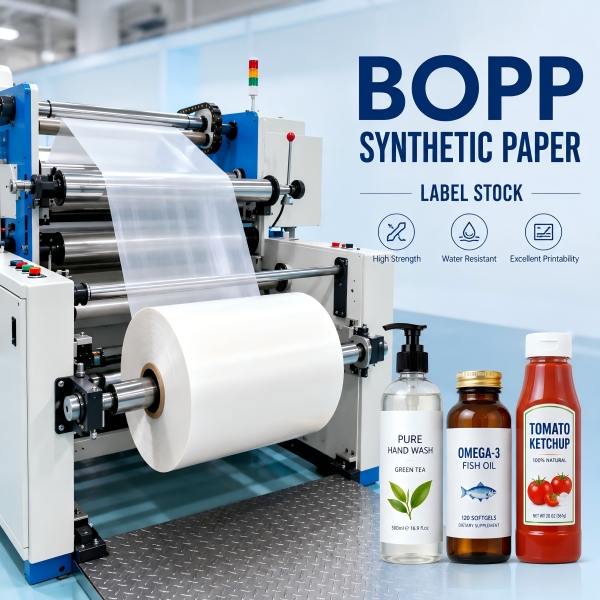
2.4 Solution Comparison: Low-Density vs. Standard-Density Pearlized BOPP
| Parameter | Low-Density Pearlized BOPP (0.60–0.65 g/cm³) | Standard-Density Pearlized BOPP (0.72–0.80 g/cm³) |
|---|---|---|
| Yield (38µm, m²/kg) | 42–46 | 30–34 |
| Cost per m² (at $2.50/kg) | $0.054–0.060 | $0.074–0.083 |
| Stiffness (MD Modulus) | Lower; may require thicker gauge for equivalent rigidity | Higher; suitable for high-speed dispensing |
| Opacity/Whiteness | Excellent due to higher void fraction | Good, but may require TiO₂ for equivalent whiteness |
| Float-Sink Recyclability | <1.0 g/cm³—fully recoverable | <1.0 g/cm³—fully recoverable |
| Best-Fit Applications | Overwrap, cosmetic labels, low-speed dispensing | Beverage wrap-around, high-speed roll-fed systems |
3. Practical Selection Guidelines
Evaluate the balance between yield and stiffness: Calculate the yield advantage of lower-density grades—a 0.63 g/cm³ film can deliver 40% more m²/kg than plain BOPP at the same thickness, but verify that mechanical properties meet your converting requirements.
Test machinability before specification changes: Lower-density pearlized BOPP may require press adjustments. Conduct trials at production speeds before committing to volume orders.
Confirm float-sink performance with your recycler: While all pearlized BOPP label films are intrinsically recyclable via float-sink separation, local recycling infrastructure may have specific feedstock requirements.
Align density with application performance: Thicker gauges (45–50µm) of low-density film can offset stiffness reductions while maintaining yield advantages.
Frequently Asked Questions
What is the typical density range for pearlized BOPP label films?
Pearlized BOPP density typically ranges from 0.55 to 0.80 g/cm³, with label grades commonly falling between 0.65 and 0.72 g/cm³. Plain BOPP density is approximately 0.91 g/cm³; the density reduction results from microscopic voids created during orientation.
Why does density affect label yield?
Yield (m²/kg) is inversely proportional to density. A 38-micron pearlized BOPP film at 0.66 g/cm³ yields approximately 39.9 m²/kg, while the same thickness at 0.80 g/cm³ yields 30.4 m²/kg. Lower-density films deliver more square metres per kilogram—a direct material cost advantage.
Can pearlized BOPP labels be recycled with standard PP streams?
Yes. All pearlized BOPP grades have density below 1.0 g/cm³, making them suitable for float-sink separation in polypropylene recycling systems. The cavitated structure does not interfere with the recycling process; voids collapse during melting, producing quality recyclate.
Which density is best for wrap-around beverage labels?
For beverage wrap-around labels, pearlized BOPP density of 0.65–0.70 g/cm³ is typical—providing sufficient stiffness for high-speed dispensing (300+ bottles/minute) while maximizing yield. Lower-density grades may be suitable for slower lines or shorter containers.
Does density affect print quality or coating adhesion?
Density itself does not directly affect printability, but surface treatment (corona to 38+ dyne/cm) is essential for ink adhesion. Lower-density films may have slightly different surface topography; confirm print performance through trials before specification changes.
Conclusion: Density as a Strategic Specification
Pearlized BOPP density is not a passive material property but a strategic lever that influences material cost, converting efficiency, and environmental performance. A density reduction from 0.80 to 0.65 g/cm³ delivers a yield increase of approximately 30%—a direct cost reduction per label that compounds across annual volumes, provided the application can accommodate the stiffness trade-off.
For converters evaluating pearlized BOPP label films, the optimal density is the lowest value that maintains required machinability and end-use performance—ensuring cost efficiency without compromising quality. For brand owners pursuing sustainability objectives, the float-sink recyclability of all pearlized BOPP grades supports circular economy commitments without requiring additional material design.




News & Events
learn more-
 Blog
Press Release Aug-14-2026
Blog
Press Release Aug-14-2026How to Make 3D Logos with TPU Film
Learn how to create premium, durable 3D logos for apparel using 3D UV DTF TPU film. Explore technical workflows, wash testing, and B2B supplier selection. -
 Blog
Press Release Aug-14-2026
Blog
Press Release Aug-14-2026What Is UV TPU 3D DTF Film? 3D Texture Transfer Guide
What is UV TPU 3D DTF film? Learn its structure, production process, 3D texture advantages, and applications in apparel, footwear, leather goods and custom products. -
 Blog
Press Release Aug-14-2026
Blog
Press Release Aug-14-2026How Humidity and Temperature Affect BOPP Film During Storage and Transit
How temperature and humidity degrade BOPP films in storage and transit - corona decay, blocking, core deformation - plus safe storage limits, a controlled vs ambient comparison, and test methods.

contact
Tel: +86 17706217416
Add: Building L2A, No. 520, Lane 1588, Zhuguang Road, Hongqiao World Center, Qingpu District, Shanghai, China
follow us: