
 English EN
 French FR
 German DE
 Portuguese PT
 Spanish ES
 Russian RU
 Japanese JA
 Korean KO
 Arabic AR
 Greek EL
 Turkish TR
 Italian IT
 Polish PL
 Hindi HI
 中国 CN
中国 CN
.webp)
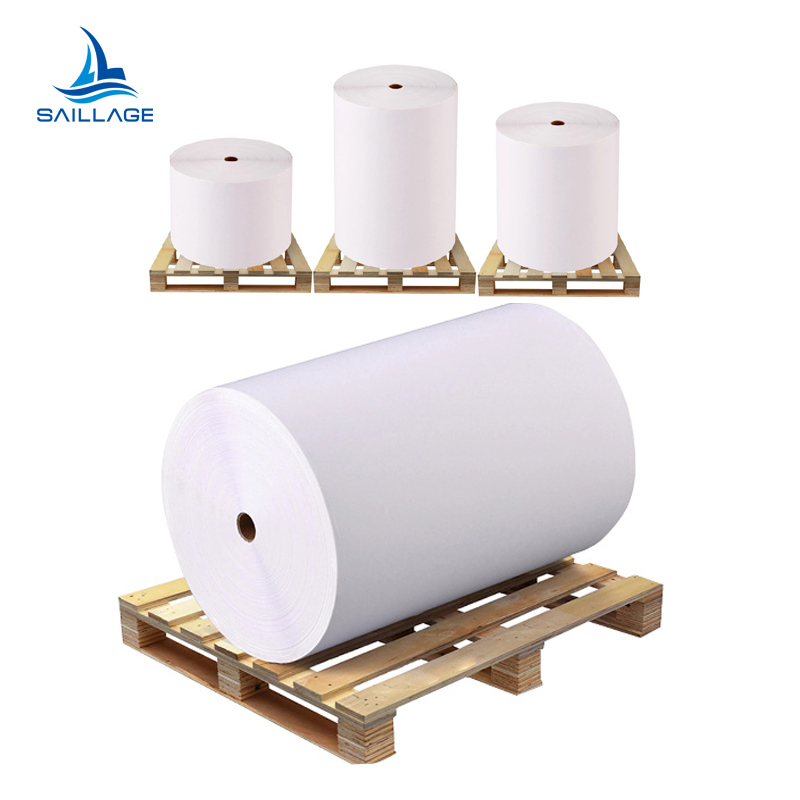
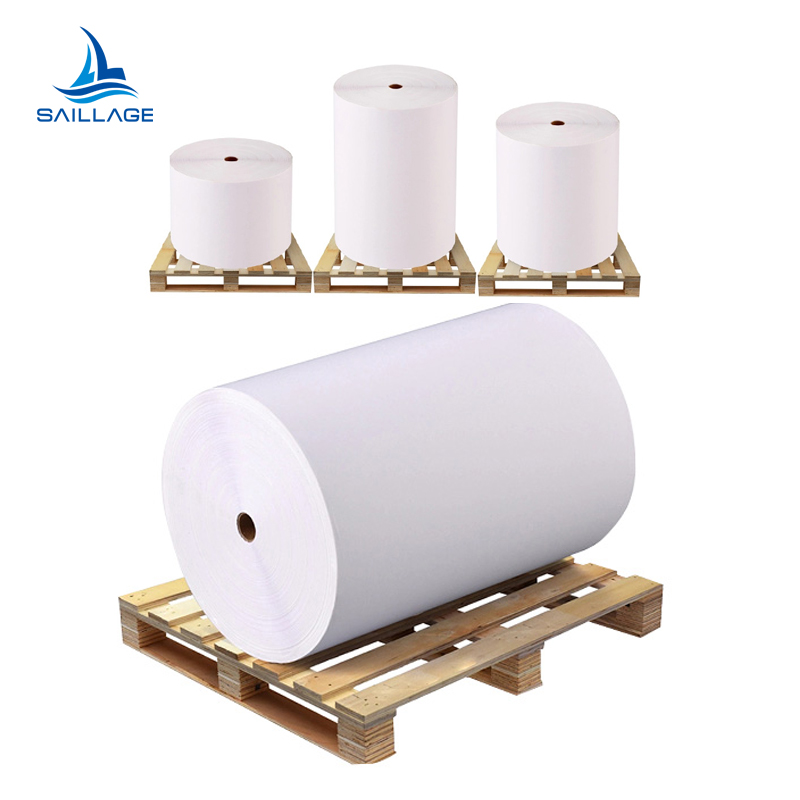
Types of Label Films Explained: How to Choose the Right Facestock (BOPP, PET, PE, PVC, Synthetic Paper)
Introduction
Selecting the right label films and label facestock is a technical decision that directly affects printing quality, converting efficiency, label appearance, and end-use performance. For label printers, film distributors, converters, and brand packaging companies, the challenge is rarely finding a film. The difficult part is matching the film structure with the printing process, application surface, environmental conditions, and required appearance.
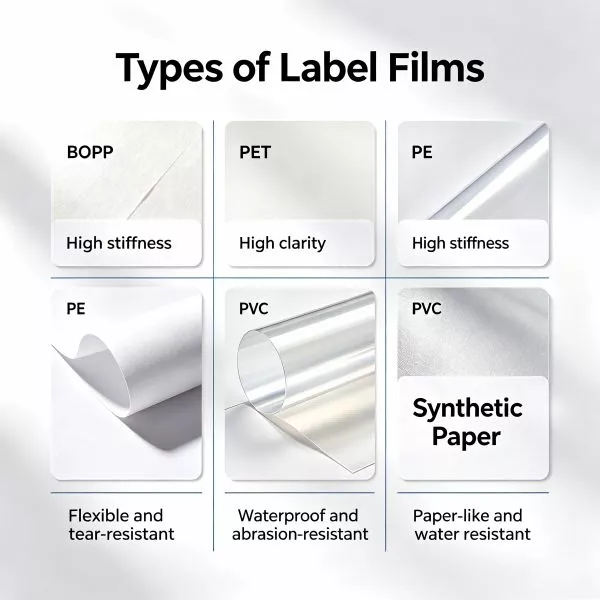
BOPP, PET, PE, PVC, and synthetic paper each have different combinations of stiffness, flexibility, dimensional stability, surface characteristics, moisture resistance, and printability. A film that performs well in UV flexographic printing may not be the best choice for wrap-around labels or inkjet printing.
Key Takeaways
BOPP label films are widely suitable for applications requiring attractive appearance, moisture resistance, and efficient high-volume printing.
PET-based films are appropriate when dimensional stability and mechanical performance are important.
PE films offer greater flexibility for curved or squeezable containers.
PVC can provide useful conformability and visual effects for selected applications.
Synthetic paper provides a paper-like appearance while retaining the durability of a film-based material.
The correct film for facestock should be selected according to the complete printing and application process rather than film price alone.
Technical Core: Understanding Label Film Facestock
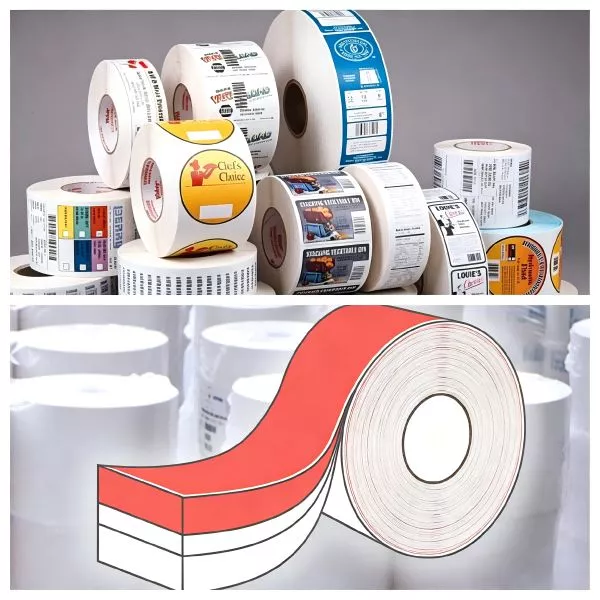
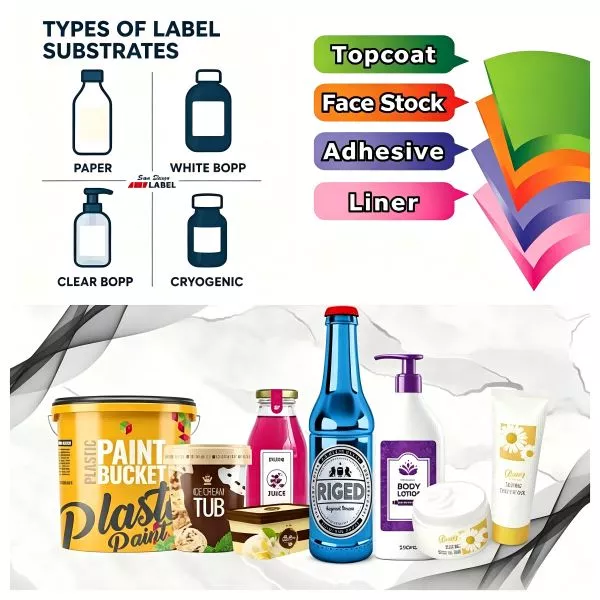
A facestock is the printable material forming the main visible layer of a pressure-sensitive label. In a typical label construction, the facestock works together with the adhesive and release liner. Its surface must provide suitable interaction with inks and coatings while maintaining the mechanical properties required during printing, die cutting, dispensing, and final application.
The choice of facestock is primarily determined by four technical factors: material properties, surface characteristics, converting behavior, and end-use conditions.
BOPP Label Films
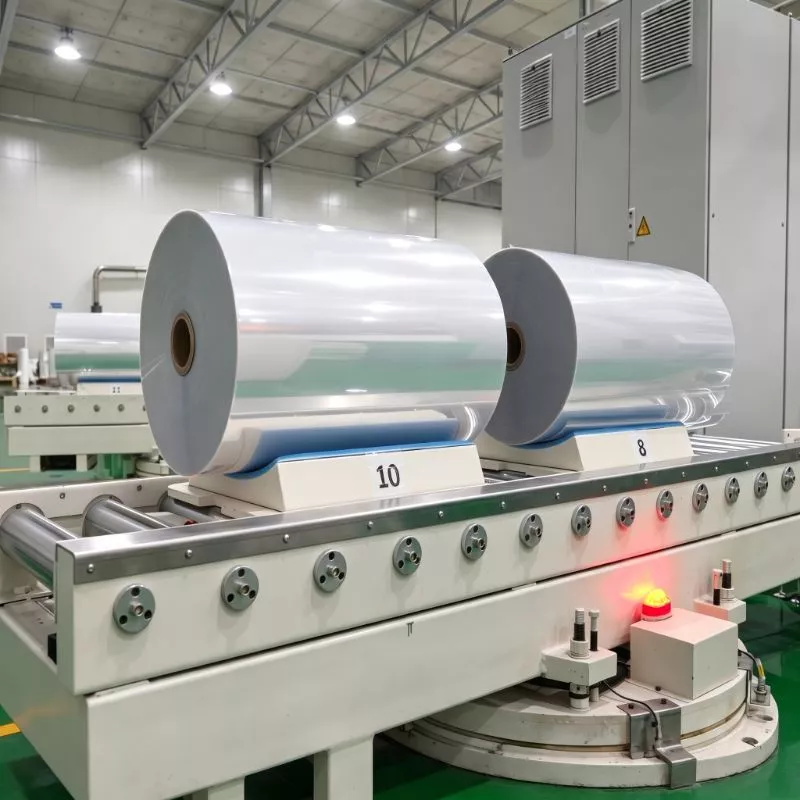
Biaxially oriented polypropylene, or BOPP, is a polypropylene film stretched in two directions to improve its mechanical and dimensional properties. BOPP is widely used for labels because it combines good moisture resistance with a clean film appearance and a broad range of surface finishes.
Depending on the required visual effect and printing process, converters may select clear, white, matte, glossy, or pearlized BOPP structures.
For example, Matte BOPP label films for UV flexo printing can be considered when a low-gloss appearance is required while maintaining compatibility with a high-productivity printing process. Glossy pearlized BOPP film for flexo printing is another option where a decorative, high-impact appearance is part of the packaging design.
PET-Based Label Films
PET, or polyethylene terephthalate, provides high dimensional stability and mechanical strength. PET based label films for inkjet printing can be suitable when stable web behavior and a controlled printable surface are important.
PET is particularly relevant when label converters need the facestock to maintain its shape during demanding printing and converting operations.
PE Label Films
Polyethylene films provide higher flexibility than many rigid film structures. This makes PE useful for applications involving curved, squeezable, or deformable containers. The key consideration is maintaining consistent label appearance and converting performance while accommodating container movement.
PVC Label Films
PVC films can offer flexibility, conformability, and a range of visual effects. However, their suitability depends heavily on the intended application, regulatory requirements, brand specifications, and the complete label construction.
Synthetic Paper
Synthetic paper is a film-based material engineered to provide a paper-like appearance and handling characteristics while offering greater resistance to moisture than conventional paper substrates. Synthetic paper for wrap around label printing can therefore be considered when the visual impression of paper is desired together with film-like durability.
Application & Solutions: How to Choose the Right Facestock
There is no universal “best” facestock. The correct selection begins with the final application and works backward toward the material.
1. Select According to the Printing Process
The printing process determines the surface requirements of the facestock.
For UV flexographic printing, surface energy, ink adhesion, drying behavior, and web stability need to be considered. A matte BOPP structure may be appropriate when the label design requires a subdued surface finish.
For digital inkjet printing, the printable surface becomes particularly important. A PET based label film for inkjet printing should be evaluated according to ink compatibility, image quality, drying, coating requirements, and resistance to handling after printing.
Flexographic printing: evaluate surface treatment, ink adhesion, web stability, and finishing requirements.
Inkjet printing: evaluate ink compatibility, surface coating, image definition, drying behavior, and rub resistance.
High-volume converting: prioritize consistent thickness, stable web behavior, clean die cutting, and reliable roll quality.
2. Match the Film to Container Geometry
Container shape is one of the most frequently overlooked factors in facestock selection.
Rigid, relatively flat surfaces can accommodate stiffer materials more easily. Curved or squeezable containers require a more flexible construction. PE can therefore be considered for applications where conformability is important, while PET may be preferred where dimensional stability has greater priority.
For wrap-around applications, synthetic paper can be evaluated when both paper-like appearance and resistance to moisture are required.
3. Define the Required Visual Appearance
Packaging appearance is not simply a design issue. The surface of the facestock directly influences how the printed graphics are perceived.
Typical choices include:
Glossy films for strong color impact and a bright surface.
Matte films for a lower-reflectivity, premium or understated appearance.
Pearlized BOPP for decorative packaging effects.
Clear films where the “no-label” appearance is required.
Synthetic paper when a paper-like visual effect is part of the packaging concept.
4. Consider Environmental Exposure
Moisture, temperature variation, mechanical handling, and exposure to the surrounding environment can affect label performance.
For applications exposed to water or humidity, film facestocks generally provide an advantage over conventional paper materials because the polymer structure is inherently resistant to moisture. However, the final performance still depends on the complete label construction, including adhesive, printing inks, coatings, and application conditions.
5. Compare the Facestock Options Systematically
A practical purchasing decision can be organized as follows:
| Selection Approach | Traditional One-Size-Fits-All Selection | Application-Specific Facestock Selection |
|---|---|---|
| Printing process | Film selected mainly by availability | Film matched to printing technology and ink system |
| Surface finish | Limited consideration | Gloss, matte, pearlized, clear, or paper-like finish selected according to design |
| Container shape | Same material used across applications | Flexibility and stiffness matched to container geometry |
| Environmental resistance | Evaluated after material selection | Moisture and handling conditions considered before selection |
| Converting efficiency | Focus mainly on purchase price | Web stability, die cutting, and processing consistency considered |
| Total cost | Lowest material price prioritized | Total production and application performance evaluated |
The second approach generally provides a more reliable basis for B2B purchasing because the objective is not simply to minimize the price per kilogram or roll. The objective is to achieve stable production and acceptable finished-label performance.
6. Build a Facestock Selection Checklist
Before approving a new label facestock, procurement teams and technical departments should confirm:
Printing process: flexographic, UV flexographic, inkjet, or another process.
Ink compatibility: verify that the selected surface supports the intended ink system.
Surface appearance: define glossy, matte, pearlized, clear, or synthetic-paper requirements.
Container geometry: determine whether the label will be applied to flat, curved, or squeezable surfaces.
Environmental conditions: identify exposure to moisture, handling, and other application conditions.
Converting requirements: assess web stability, die cutting, slitting, and roll consistency.
Finished-label performance: evaluate the complete label construction rather than judging the facestock independently.
Supply consistency: confirm that the supplier can maintain consistent film quality between production batches.
For distributors and label converters, maintaining several qualified facestock options can also reduce the risk of forcing one material into applications for which it was not designed.
FAQ: Label Film and Facestock Selection
What is the difference between label film and label facestock?
The term label film generally describes the polymeric film material used in a label construction, while facestock refers to the main printable layer of the label. In many film-label applications, the two terms overlap because the film itself serves as the facestock.
Is BOPP the best label facestock?
There is no universal best material. BOPP is a strong option for many applications because it combines attractive appearance, moisture resistance, and versatile printing possibilities. However, PET, PE, PVC, or synthetic paper may be more appropriate when dimensional stability, flexibility, conformability, or a paper-like appearance is the primary requirement.
When should I choose PET instead of BOPP?
PET should be considered when dimensional stability and mechanical strength are important selection criteria. The final decision should also consider the printing technology, surface treatment, converting process, and application environment.
Which film is suitable for wrap-around label printing?
Synthetic paper can be considered for wrap-around label printing when the application requires a paper-like appearance together with film-based durability. The specific material should still be validated against the printing and application process.
Conclusion & B2B Action Guide
Choosing the right film for facestock is a process-engineering decision rather than a simple material purchase. BOPP, PET, PE, PVC, and synthetic paper each provide different combinations of printability, stiffness, flexibility, appearance, and environmental resistance.
For label converters, distributors, and brand packaging teams, the most reliable approach is to define the printing process, container geometry, appearance, environmental exposure, and converting requirements before selecting the film.
If you are evaluating BOPP label films, PET label films, synthetic paper, or other label facestock materials, discuss your printing process and end-use requirements with a technical supplier. Providing application details and requesting representative samples can help your engineering and purchasing teams validate the material before moving to full-scale production.





contact
Tel: +86 17706217416
Add: Building L2A, No. 520, Lane 1588, Zhuguang Road, Hongqiao World Center, Qingpu District, Shanghai, China
follow us: