
 English EN
 French FR
 German DE
 Portuguese PT
 Spanish ES
 Russian RU
 Japanese JA
 Korean KO
 Arabic AR
 Greek EL
 Turkish TR
 Italian IT
 Polish PL
 Hindi HI
 中国 CN
.webp)
PETG Shrink Film Master Rolls: A Converter Specification and RFQ Guide
Introduction
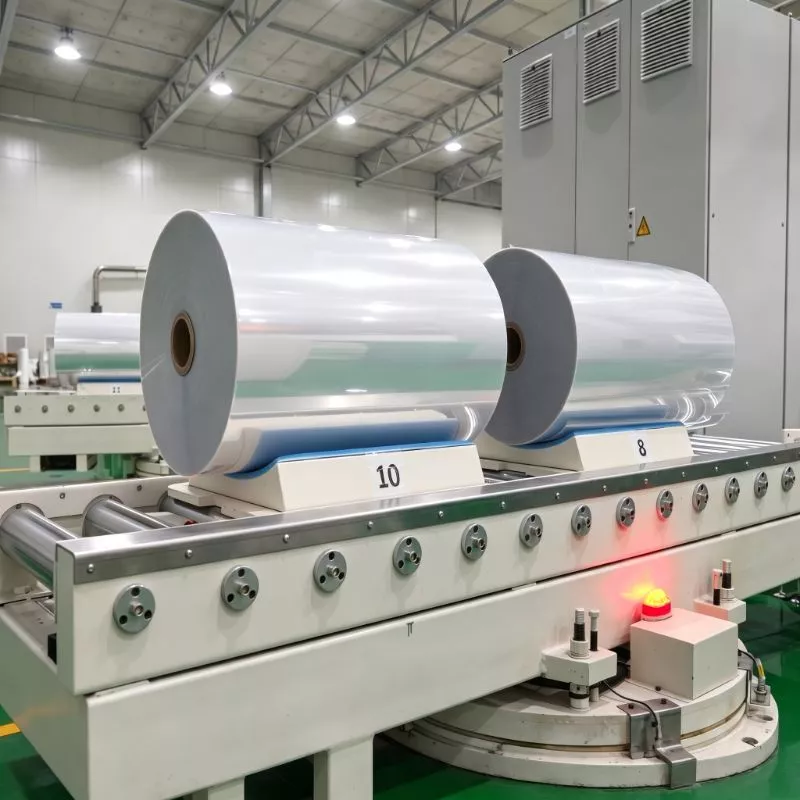
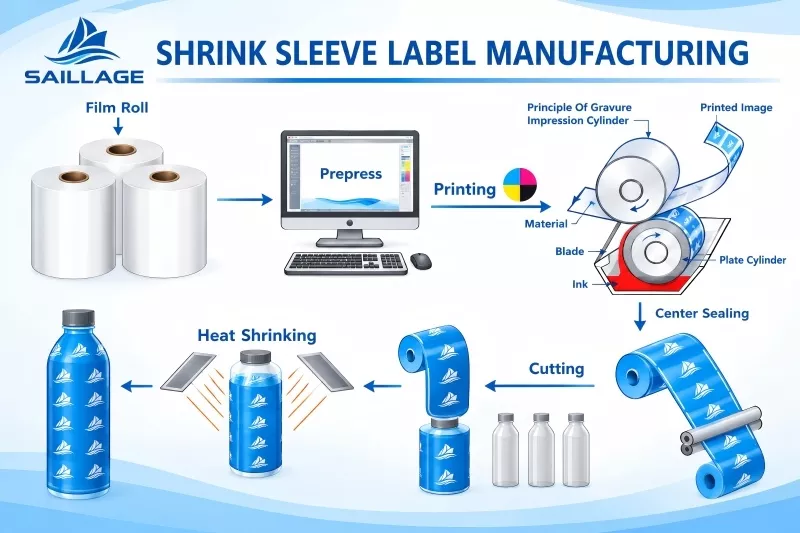
A converter can lose production time before the first sleeve reaches the filling line if a PETG master roll arrives with an unsuitable shrink curve, inconsistent gauge, poor winding, or incomplete technical documentation. PETG Shrink Film Master Rolls are not interchangeable simply because they share a polymer family. Film orientation, thickness, shrink force, shrink onset, surface treatment, and roll geometry all influence printing, seaming, slitting, sleeve forming, and final container fit.
For purchasing teams and shrink sleeve manufacturers, the practical task is to translate the final package requirement into a measurable film specification. A high-shrink design for a full-body contoured bottle label may require a different shrink profile from a medium-shrink film for a relatively straight container. A low-shrink PET-G film may be more appropriate where dimensional change must remain limited. Selecting by price per kilogram alone can obscure waste, setup time, and line-efficiency costs.
Key Takeaways
specify the intended application and shrink profile
compare shrink data by direction and test condition
define thickness, width, winding, surface, and packaging requirements
and issue a request for quotation (RFQ) that allows suppliers to quote on a comparable basis. The aim is not to choose the most aggressive shrink film, but the grade that runs reliably on the converter’s process and performs on the finished package.
.jpg)
Technical Core: What a Master-Roll Specification Must Control
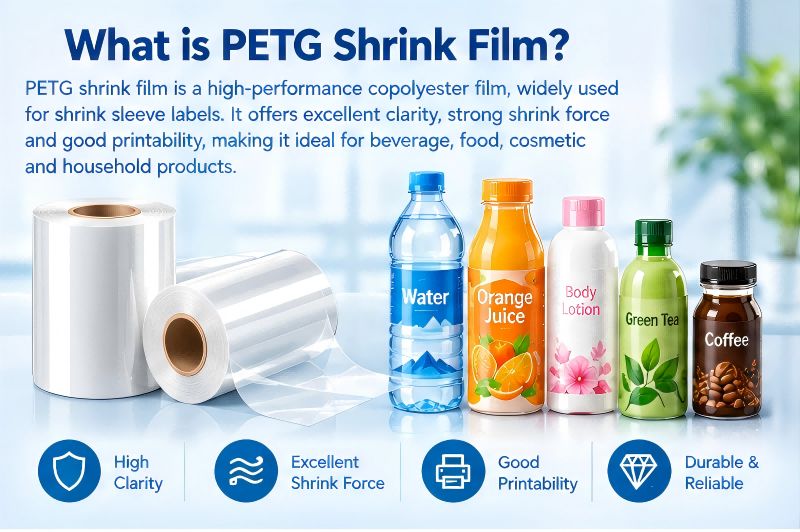
PETG (polyethylene terephthalate glycol-modified) is a copolyester used for shrink sleeve films. During film manufacture, stretching or orientation stores molecular orientation in the film. When heated, the oriented structure relaxes and the film contracts. This heat-induced dimensional change is called thermal shrinkage. The amount and rate of shrinkage depend on the film grade, orientation, temperature, exposure time, and test method. A shrink percentage without its direction and test conditions is therefore incomplete information.
Shrink profile: High Shrink PET-G Film roll is typically considered when a sleeve must conform to pronounced shoulders, waists, or complex container contours. Medium Shrink PETG Film can suit moderate contours and applications where a balance between conformability and process control is required. A low shrink pet-g film may be appropriate for simpler shapes or designs where excessive contraction could distort graphics or create fit problems. These labels are commercial descriptions, not universal classifications: suppliers may use different ranges, so buyers should request actual TD and MD shrink curves. TD means transverse direction, across the web; MD means machine direction, along the web.
Gauge and dimensional control: film thickness affects stiffness, handling, material consumption, and the way a sleeve behaves during converting. The RFQ should state nominal thickness and allowable tolerance, roll width and tolerance, core inside diameter, maximum roll diameter, net weight range, and winding direction. Tolerances should be agreed with the supplier rather than assumed from a generic industry value. For wide webs or high-speed lines, gauge variation and edge quality can influence tracking and slitting yield.
Surface and printability: surface energy is an indicator of how readily a liquid may wet a surface, but it does not by itself guarantee ink adhesion. The converter should specify which side is intended for printing, whether treatment is required, and any agreed surface-energy target and test method. Ink system, primer, drying conditions, storage time after treatment, and contamination can all affect print performance. A trial on the actual ink and press combination is more informative than relying on a single surface-energy number.
Roll construction and documentation: winding hardness, telescoping, starring, blocking, edge damage, and contamination can cause stoppages or waste. Each roll should be traceable to a production lot and labelled with grade, thickness, width, roll number, net weight, manufacturing date or lot code, and handling information. A supplier’s technical data sheet (TDS) describes the grade; a certificate of analysis or inspection report should record the agreed results for the supplied lot. Buyers should confirm which documents are available before placing the order.
Application & Solutions: Build the Specification Around the Converting Line
1. Start with the finished container and sleeve design.
For a shrink sleeve label converter, the bottle or container geometry is the first specification input. Record the maximum body diameter, minimum diameter, shoulder transitions, recesses, label height, and any areas that must remain clear of seams or perforations. Full-body shrink sleeve labels often demand greater conformability than a straight-sided label. A petg shrink film jumbo roll for full-body shrink sleeve lables should therefore be selected against the container’s contour and the sleeve design, not solely by a “high shrink” description.
2. Define the shrink profile and the test basis.
Ask the supplier for shrinkage data in both TD and MD, with the test medium or heating method, temperature, exposure time, specimen preparation, and calculation basis clearly stated. Use comparable test conditions when evaluating suppliers. A single maximum-shrink figure can hide important differences in shrink onset and curve shape. If the sleeve must pass through steam or hot-air equipment, conduct trials using the actual tunnel settings and container geometry. Confirm whether the shrink profile leaves enough process window to avoid wrinkles, bridging, graphic distortion, or excessive stress around the seam.
.jpg)
3. Match thickness and web width to the press and sleeve-forming process.
The selected gauge should balance print handling, sleeve strength, container conformity, and cost per label. Thinner film may reduce material use but can be more sensitive to tension, static, wrinkles, and handling damage. Thicker film may improve handling in some conditions but can require different forming or shrinking settings. Set width according to the press, slitter, and sleeve dimensions, and state width tolerance explicitly. If a converter runs multiple products, ask whether the supplier can offer a controlled range of widths while maintaining the same grade and documented shrink profile.
4. Treat printability as a process qualification, not a label claim.
For clear petg shrink film wholesale for beverage bottel labels, buyers should confirm optical appearance, print-side identification, treatment status, and compatibility with the intended inks and curing or drying system. Establish acceptance criteria for wetting, ink adhesion, scuff resistance, and visual defects. These criteria should be tested on production-representative samples. Avoid assuming that a film suitable for one ink chemistry or press will behave identically with another. Store trial rolls under the supplier’s stated conditions and record the time between opening, printing, and testing.
5. Set measurable incoming inspection and lot-release criteria.
A practical incoming plan may include checks for packaging integrity, roll identification, width, thickness, gross/net weight where relevant, edge condition, winding, visible contamination, and agreed shrinkage or surface properties. The inspection frequency and sample size should reflect order volume, supplier performance, and the risk of line disruption. Where a property cannot be verified by a simple warehouse check, request a lot-specific report and periodically confirm it through an internal or third-party test. Define how nonconforming rolls will be quarantined, investigated, replaced, or credited.
6. Include storage and transport requirements in the purchase order.
PETG film should be protected from dust, moisture exposure, physical impact, and uncontrolled temperature conditions. Store rolls in their original protective packaging until use, avoid loading damage to roll edges, and follow the supplier’s temperature and acclimatization guidance. Before printing, allow a cold roll to reach the production-room environment while remaining wrapped as recommended, reducing the risk of condensation. State pallet type, roll orientation, edge protection, wrapping, label placement, and any export packing requirements in the RFQ. These details matter particularly for long-distance shipments and warehouse transfers.
7. Compare quotations on a total-conversion-cost basis.
A low unit price does not necessarily deliver the lowest cost per acceptable sleeve. Compare price per kilogram or square metre alongside expected yield, splice frequency, setup waste, defect rate, line speed, and the cost of rejected printed material. Use a controlled trial to validate assumptions before switching grades. When changing suppliers, avoid changing film grade, ink, press settings, and shrink-tunnel settings at the same time; otherwise, the cause of a performance change becomes difficult to identify.
The table below contrasts two procurement approaches. The “traditional” column represents a common but incomplete purchasing practice, not a claim that every converter follows it.
Traditional Purchase vs. Controlled Specification and RFQ
| Dimension | Traditional purchase approach | Controlled specification and RFQ |
|---|---|---|
| Grade selection | Choose by “high/medium shrink” label or price | Compare TD/MD shrink curves and stated test conditions |
| Print performance | Assume film is compatible with the current ink | Confirm print side, treatment, ink system, and trial acceptance criteria |
| Incoming quality | Check packaging and visible defects only | Agree measurable limits, sampling, traceability, and lot-specific records |
| Cost assessment | Compare unit price per kg | Evaluate cost per acceptable sleeve, yield, waste, and line interruptions |
| Risk control | Resolve issues after production starts | Qualify samples and document deviations before order approval |
RFQ Checklist: Information to Send a PETG Heat Shrink Base Film Supplier
☑ Application: beverage label, personal-care container, household product, or other end use; full-body or partial sleeve.
☑ Container and sleeve: drawing or dimensions, contour details, sleeve height, target fit, and any perforation or seam requirements.
☑ Grade: requested High Shrink PET-G Film, Medium Shrink PETG Film, or low shrink pet-g film, with the required TD/MD shrink curve and test conditions.
☑ Film dimensions: nominal thickness and tolerance, roll width and tolerance, core size, maximum roll diameter, and acceptable net-weight range.
☑ Printing: print side, surface treatment status, agreed surface-energy target if applicable, ink system, press type, and curing/drying method.
☑ Quality: acceptance criteria for appearance, gauge, width, shrinkage, surface condition, roll winding, and packaging integrity.
☑ Traceability: roll-level labels, lot number, TDS, lot-specific inspection or analysis report, and change-notification expectations.
☑ Logistics: order quantity, roll count, pallet configuration, protective packaging, storage conditions, shipping destination, and required delivery date.
☑ Qualification: sample-roll quantity, trial plan, test responsibilities, approval criteria, and the process for handling nonconforming material.
A well-prepared RFQ lets a petg heat shrink base film supplier from China respond with fewer assumptions. If a requirement is not yet known, mark it as “to be confirmed” and ask the supplier to identify the available options rather than silently accepting an unspecified value.
.jpg)
FAQ
Is “high shrink” a standard grade classification?
Not universally. Treat high, medium, and low shrink as descriptive commercial terms until the supplier provides numerical TD/MD data, the test method, and the test conditions. Compare the actual shrink curves and validate the result on the target container.
Should I specify shrinkage only at the maximum test temperature?
No. Request the full curve or several agreed test points where available. Shrink onset and the rate of shrinkage can be as important as the maximum value because they affect tunnel setup, wrinkle formation, and container conformity.
What documents should accompany a master roll shipment?
At minimum, agree on a grade TDS, roll labels with traceable lot identification, packing information, and a lot-specific inspection report or certificate covering the parameters agreed in the purchase order. Do not assume a certificate contains tests that were not agreed or performed.
How can I compare suppliers fairly?
Send each supplier the same container information, grade target, test basis, dimensional tolerances, print requirements, packing details, and acceptance criteria. Compare quoted specifications first, then evaluate representative samples under the same converting conditions. Record any deviations before approving a production order.
Conclusion & B2B Action Guide
Reliable PETG Shrink Film Master Rolls begin with a specification that connects the finished sleeve to the converter’s real process. Shrink profile, thickness, width, print-side condition, winding quality, traceability, and packaging should be defined together. The most useful RFQ does not ask only for a price; it gives suppliers enough information to quote a technically comparable material and gives the converter a measurable basis for approval.
Before your next purchase, prepare a container drawing, define the required TD/MD shrink behaviour, list the printing and converting conditions, and agree on incoming acceptance criteria. Share the specification with shortlisted suppliers and request samples for a controlled trial. A qualified supplier should be able to clarify limitations, identify open parameters, and provide documentation that matches the agreed scope. This process helps procurement, engineering, production, and warehouse teams work from the same specification before the first commercial roll is dispatched.




News & Events
learn more-
.webp) Blog
Press Release Nov-04-2026
PETG Shrink Film Master Rolls: A Converter Specification and RFQ Guide
A converter can lose production time before the first sleeve reaches the filling line if a PETG master roll arrives with an unsuitable shrink curve, inconsistent gauge, poor winding, or incomplete technical documentation. PETG Shrink Film Master Rolls are not interchangeable simply because they share a polymer family. Film orientation, thickness, shrink force, shrink onset, surface treatment, and roll geometry all influence printing, seaming, slitting, sleeve forming, and final container fit. -
 Blog
Press Release Nov-04-2026
DTF Transfer Problems Before Heat Pressing: How to Check for Oiling, Moisture and Film Defects
Learn how to inspect stored DTF transfers for oiling, moisture, coating damage and other film defects before committing to a full heat-press run. -
 Blog
Press Release Nov-04-2026
PETG Shrink Sleeve Base Film for Printing: Surface and Ink-Adhesion Trial Checklist
Use this PETG shrink sleeve printing checklist to evaluate surface condition, ink wetting, drying, adhesion, converting and shrink-trial performance.

contact
Tel: +86 17706217416
Add: Building L2A, No. 520, Lane 1588, Zhuguang Road, Hongqiao World Center, Qingpu District, Shanghai, China
follow us: