
 English EN
 French FR
 German DE
 Portuguese PT
 Spanish ES
 Russian RU
 Japanese JA
 Korean KO
 Arabic AR
 Greek EL
 Turkish TR
 Italian IT
 Polish PL
 Hindi HI
 中国 CN
.webp)
PETG Film Roll: Prevent Dog-Ears on Contour Bottles h1: High-Shrink PETG vs. Complex Bottle Contours: Defect Prevention
High-Shrink PETG vs. Complex Bottle Contours: Defect Prevention
Applying shrink sleeves to high-contour packaging—such as trigger sprayers, hourglass beverage bottles, and asymmetric cosmetic containers—pushes flexible packaging materials to their absolute limits. When engineering tolerances fail, production lines face two notorious defects: "dog-ears" (bunching and folding at sharp radii) and the "smiling effect" (uneven, upward curling at the base).
These cosmetic failures are not merely aesthetic; they compromise tamper evidence, distort branding, and lead to unacceptable scrap rates. The root cause usually traces back to an improper match between the container's geometry and the thermal dynamics of the chosen PETG shrink film. Selecting an optimized PETG film roll with precise Transverse Direction (TD) and Machine Direction (MD) ratios is mandatory for securing high-yield, high-speed application.
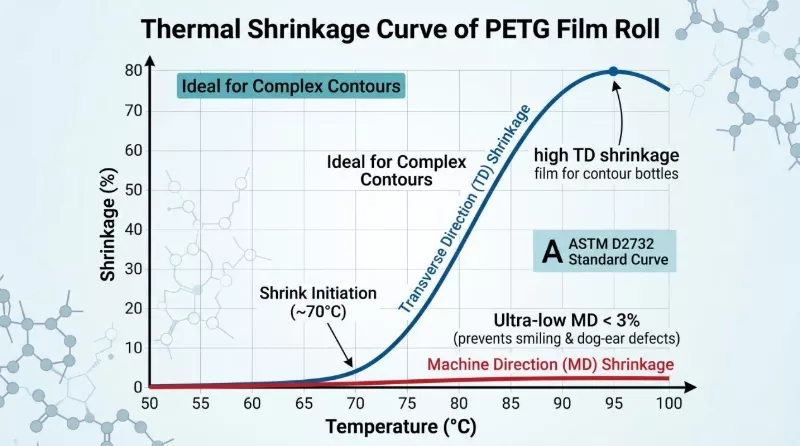
To eliminate dog-ears and smiling effects on complex contours, packaging engineers must specify a high TD shrinkage film for contour bottles (typically 75%–80% TD) with an ultra-low MD shrinkage (<3%). Combining this specialized substrate with a multi-zone steam tunnel—locking the base first before shrinking the neck—prevents vertical film migration and ensures defect-free conformity.
Key Takeaways
TD vs. MD Ratios: Extreme contours require >75% TD shrinkage and strict <3% MD shrinkage to prevent vertical distortion.
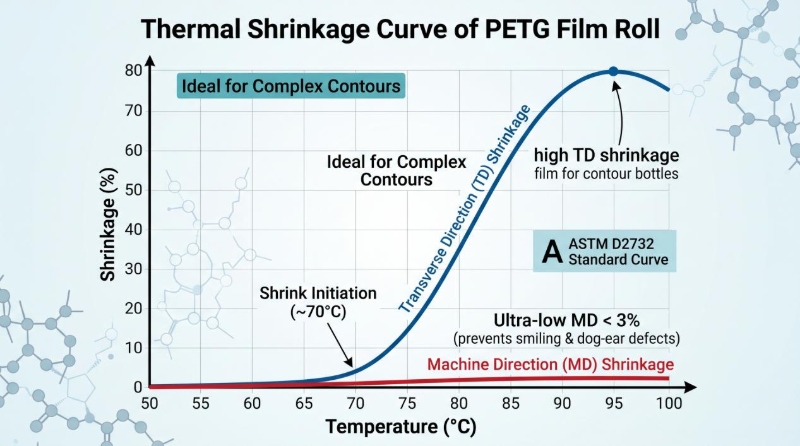
Heat Curve Control: PETG's low shrink initiation temperature (approx. 70°C) requires zoned thermal application to prevent premature anchoring.
Tension Consistency: Sourcing custom slitting PETG raw film from a specialized PETG shrink film factory prevents edge-gauge variations that cause corner folding.
Steam Tunnel Superiority: Steam tunnels provide the 360-degree, uniform thermal transfer necessary for high-shrink PETG, drastically outperforming radiant heat on asymmetric bottles.
Core Technical Analysis: The Mechanics of Shrinkage Defects
Understanding how a PETG film roll behaves under thermal stress is critical to diagnosing sleeve defects. Shrink film memory is programmed during the biaxial or uniaxial orientation process during manufacturing. When reheated (tested under standard ASTM D2732 protocols), the polymer chains attempt to return to their un-oriented state.
The Physics of the "Dog-Ear"
A dog-ear defect is a physical folding of the film at the container's shoulders, cap edge, or base corners. It occurs when the excess film cannot shrink fast enough or far enough to hug a sharp radius.
This defect is triggered by three interacting variables:
Insufficient TD Shrinkage: If the difference in diameter between the bottle's widest point (the slip-on diameter) and its narrowest point (the neck) exceeds the film's maximum TD shrink capacity, the material will bunch.
Excessive MD Shrinkage: If the vertical (MD) shrinkage exceeds 3-5%, the film acts like a tightening rubber band pulling upward and downward simultaneously. This vertical tension lifts the material off the shoulder contour, creating an air gap that folds into a dog-ear under heat.
Uneven Heat Dissipation: Rapid, un-zoned heat shocks the film, causing localized locking before the surrounding material can conform.
The Dynamics of the "Smiling Effect"
The smiling effect manifests as a curved, uneven bottom edge where the film pulls up higher on one side of the bottle than the other.
Improper Anchoring: If the heat tunnel activates the middle or top of the sleeve before the bottom, the shrinking film pulls the un-anchored bottom edge upward.
Container Geometry: Tapered bases or asymmetrical bottoms naturally encourage the film to slide up the path of least resistance during the glass transition phase (Tg).
Gauge Variation: If the film edge is thicker on one side due to poor slit quality, it requires more thermal energy to shrink, resulting in uneven contraction rates.
Application Scenarios & Deep-Dive Solutions
Solving contour application issues requires a dual approach: specifying the exact correct film substrate and optimizing the mechanical application environment.
1. Specifying High TD Shrinkage Film for Contour Bottles
Standard PETG offers around 60-65% TD shrinkage, which is adequate for standard cylinders. However, complex geometries demand highly oriented substrates. Engineers must specify high TD shrinkage film for contour bottles, capable of reaching up to 78-80% TD contraction.
When establishing parameters with a PETG shrink film factory, mandate the following specifications:
Shrink Curve: The film should exhibit a gradual shrink curve rather than a steep cliff. A gradual curve (initiating at ~70°C and maxing at ~95°C) allows the trapped air to escape smoothly, preventing wrinkling.
MD Shrinkage Cap: Specify an MD shrinkage of < 3% (ideally < 2% if the geometry is highly complex).
Coefficient of Friction (COF): Specify an internal COF of 0.15–0.25 to ensure the sleeve drops over the contour seamlessly without static cling or mechanical bridging.
2. The Importance of Custom Slitting
Many printing converters overlook the mechanical tension applied during slitting. Requesting custom slitting PETG raw film from a reputable supplier ensures that the film roll maintains uniform tension across the web.
Edge Warping: Poor slitting stretches the edges of the film. When this stretched edge passes through the heat tunnel, it shrinks unpredictably, acting as the primary catalyst for the smiling effect.
Oscillating Rewind: Ensure your PETG shrink film roll supplier utilizes oscillating rewinding techniques to prevent gauge bands, which cause uneven tension on the printing press and the seaming machine.
3. Thermal Tunnel Optimization
Even the highest-grade PETG film roll will fail if the thermal environment is poorly designed. For complex contours, steam tunnels are non-negotiable. Radiant heat is directional and struggles to penetrate complex shapes uniformly, often leaving cold spots that form dog-ears.
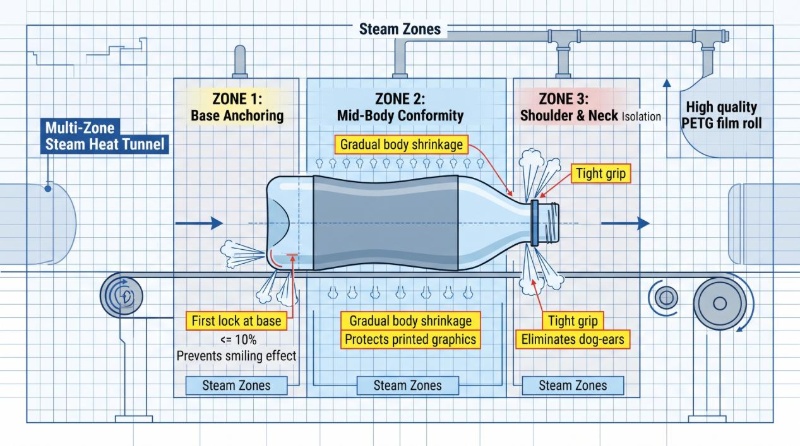
Actionable Heat Tunnel Steps for Contour Bottles:
Base Anchoring: Configure the first steam zone to direct low-pressure steam exclusively at the bottom 10% of the bottle. This "locks" the sleeve at the base, preventing the vertical migration that causes smiling.
Mid-Body Conformity: The second zone should apply ambient, uniform steam to the main body, allowing the printed graphics to shrink proportionally without distortion.
Shoulder and Neck Isolation: The final zone requires targeted, higher-pressure steam to force the film into the sharp radii of the shoulders and neck, eliminating dog-ears.
Material Comparison for Contour Applications
To understand why specialized PETG is the industry standard for complex shapes, compare its properties against legacy materials.
| Metric | Standard PVC | Standard PETG | High-Shrink PETG (Optimized) |
|---|---|---|---|
| Max TD Shrinkage | 50 - 55% | 60 - 65% | 78 - 80% |
| Max MD Shrinkage | Up to 5% | 3 - 4% | < 2% |
| Shrink Initiation Temp | ~60°C | ~70°C | ~70°C (Controlled Curve) |
| Suitability for Contours | Poor (Dog-ears common) | Fair (Mild smiling) | Excellent |
| Environmental Profile | Low (Chlorine base) | High (Recyclable) | High (Recyclable) |
Frequently Asked Questions
What causes the smiling effect on PETG shrink sleeves?
The smiling effect occurs when the bottom edge of the shrink sleeve curls upward unevenly during the thermal process. This is caused by premature heat exposure to the mid-section of the bottle before the base is properly anchored, combined with an excessive Machine Direction (MD) shrinkage rate exceeding 3%.
How does MD shrinkage contribute to dog-ear defects?
Dog-ears form when the film fails to lay flat over complex corners or sharp radii. If MD shrinkage is too high, the vertical tension pulls the film away from the contour, causing the excess Transverse Direction (TD) material to bunch up and fold over itself at the top or bottom edges.
What is the ideal TD shrinkage for asymmetric contour bottles?
For highly asymmetric or extreme contour bottles (like trigger sprays or hourglass shapes), a high TD shrinkage film ranging from 75% to 80% is ideal. This allows the film to conform tightly to the smallest radius (e.g., the neck) without bridging or distorting at the widest diameter.
Conclusion & Next Steps
Conquering dog-ears and the smiling effect on contour packaging is a matter of strict material science and precise thermal control. By limiting Machine Direction shrinkage and maximizing Transverse Direction capabilities, packaging engineers can maintain strict graphic fidelity and achieve near-zero defect rates on the most aggressive bottle shapes.
Achieving this requires a supply chain partner capable of adhering to ultra-tight manufacturing tolerances. To evaluate how precise film formulations can resolve your specific application defects, contact a specialized PETG shrink film roll supplier today to request technical data sheets, arrange a custom slitting trial, or order sample rolls for your steam tunnel qualification runs.



News & Events
learn more-
 Blog
Press Release Nov-11-2026
PETG Film Roll: Prevent Dog-Ears on Contour Bottles h1: High-Shrink PETG vs. Complex Bottle Contours: Defect Prevention
Master high TD shrinkage film for contour bottles to eliminate dog-ears and smiling effects. Increase yield by 15% with optimized PETG film roll selection. -
.webp) Blog
Press Release Nov-11-2026
PETG Shrink Film Master Rolls: A Converter Specification and RFQ Guide
A converter can lose production time before the first sleeve reaches the filling line if a PETG master roll arrives with an unsuitable shrink curve, inconsistent gauge, poor winding, or incomplete technical documentation. PETG Shrink Film Master Rolls are not interchangeable simply because they share a polymer family. Film orientation, thickness, shrink force, shrink onset, surface treatment, and roll geometry all influence printing, seaming, slitting, sleeve forming, and final container fit. -
 Blog
Press Release Nov-11-2026
PETG Shrink Sleeve Base Film for Printing: Surface and Ink-Adhesion Trial Checklist
Use this PETG shrink sleeve printing checklist to evaluate surface condition, ink wetting, drying, adhesion, converting and shrink-trial performance.

contact
Tel: +86 17706217416
Add: Building L2A, No. 520, Lane 1588, Zhuguang Road, Hongqiao World Center, Qingpu District, Shanghai, China
follow us: