
 English EN
 French FR
 German DE
 Portuguese PT
 Spanish ES
 Russian RU
 Japanese JA
 Korean KO
 Arabic AR
 Greek EL
 Turkish TR
 Italian IT
 Polish PL
 Hindi HI
 中国 CN
中国 CN
.webp)
High vs Medium Shrink PETG Film: Read the TD/MD Curve Before Selecting a Master Roll
Introduction
A shrink sleeve can look correct on the artwork proof and still fail on the packaging line. Common causes include incomplete coverage around shoulders, distorted graphics, wrinkles near the base, and excessive stress around bottle transitions. These problems are often linked not to print quality alone, but to a mismatch between the film’s shrink profile and the container geometry. When comparing a High Shrink PETG Film roll with Medium Shrink PETG Film, buyers should read the transverse-direction (TD) and machine-direction (MD) shrink curves before approving a master roll.
Heat-shrink PETG films are glycol-modified polyethylene terephthalate films engineered to contract when heated. Their performance depends on the temperature at which shrinkage begins, the amount of free shrink in each direction, the rate of shrink through the heating range, and the process window available on the customer’s equipment. A “high-shrink” label is not enough to predict line performance, and “medium shrink” does not automatically mean lower quality. The right choice is the film whose measured shrink behavior matches the container, sleeve design, printing, seaming, and tunnel conditions.
Key Takeaways
compare TD and MD curves rather than relying on a single maximum-shrink figure.
confirm shrinkage at the actual tunnel temperature and dwell time.
evaluate bottle geometry and artwork distortion together.
and qualify a sample roll on the intended line before committing to production volume.
Technical Core: What the TD/MD Shrink Curve Tells You
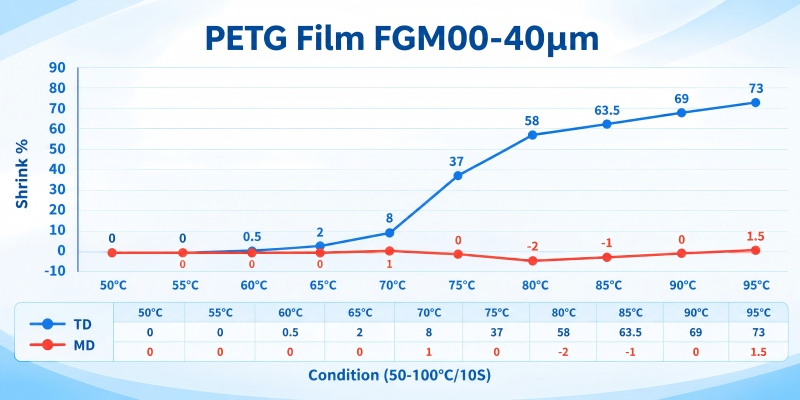
A shrink curve plots the percentage of dimensional contraction against temperature under defined test conditions. TD means transverse direction, across the web; MD means machine direction, along the web. For shrink sleeve applications, TD shrink is usually the principal driver of circumferential fit around the container, while MD shrink affects sleeve height, top and bottom registration, and the position of graphics relative to bottle features. The exact result depends on how the sleeve is cut, oriented, seamed, and applied.
Free shrink is commonly calculated as the percentage reduction in a marked specimen after exposure to a specified temperature for a specified time. Because test methods, specimen dimensions, heating medium, and exposure time affect the result, figures from different suppliers should not be compared unless the test conditions are equivalent. Ask for the test method and full temperature curve, not just a headline value such as “up to 75% shrink.” The curve should identify the test temperature range and distinguish TD from MD results.
Three features deserve particular attention. Shrink onset is the temperature range where measurable contraction begins. If the film starts shrinking too early for the line’s heat distribution, it may tighten before the sleeve has settled into position. Shrink rate describes how quickly contraction increases as temperature rises. A steep curve can help a sleeve conform quickly, but may leave a narrow operating window if the tunnel temperature or residence time fluctuates. Maximum or plateau shrink indicates the upper contraction reached under the stated test conditions; it does not show whether the film will shrink evenly on a real container.
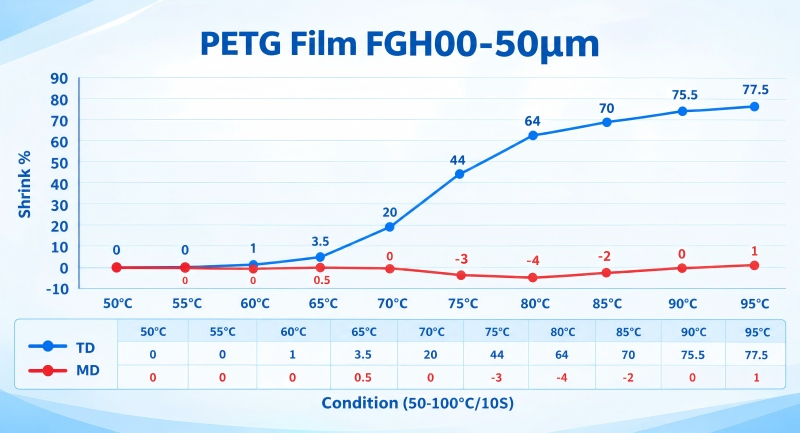
High-shrink PETG is generally considered when a sleeve must cover pronounced shoulders, waists, recessed panels, or other complex contours. Medium Shrink PETG Film can be suitable for containers with less demanding geometry or designs where controlled contraction and graphic stability are priorities. Low shrink PETG film may be relevant for simpler shapes or applications that require limited dimensional change, but its suitability must be checked against coverage requirements. These categories are commercial descriptions rather than universal grades with identical values across every producer.
The film’s shrink behavior is also influenced by thickness, orientation history, storage, printing and curing conditions, seaming quality, and the thermal profile of the shrink tunnel. A TD/MD curve is therefore a selection tool, not a guarantee. It must be interpreted alongside the converter’s process settings and the container’s three-dimensional profile.
Application & Solutions: Match Film Behavior to the Package
1. Full-body sleeves on contoured beverage bottles
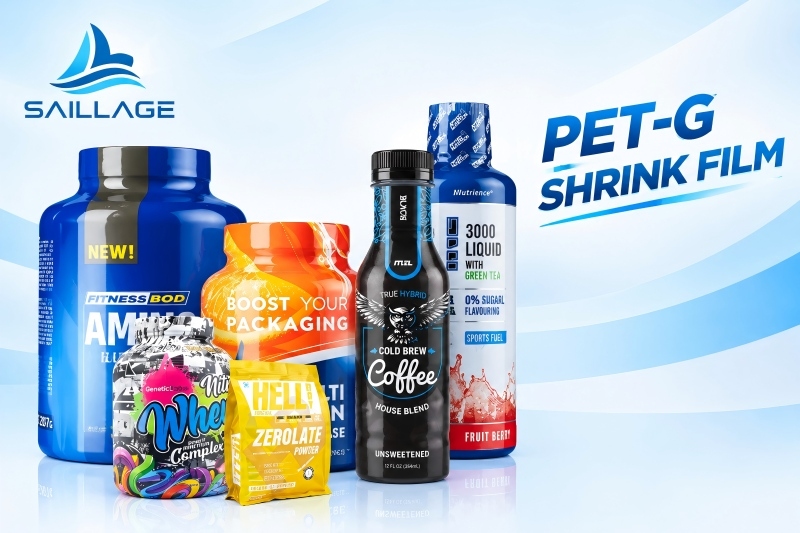
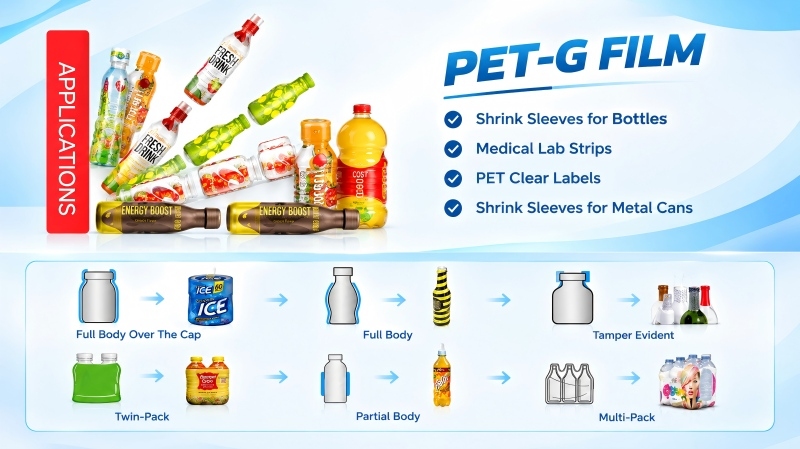
For PET-G films for full-body shrink sleeve labels, the critical question is whether the sleeve can reach the narrowest and widest sections of the bottle without creating folds, unshrunk bridges, or unacceptable graphic distortion. High Shrink PETG Film for beverage bottle labels is often worth evaluating when the package has a pronounced shoulder, waist, or molded grip. Compare TD shrink at the tunnel’s effective temperature with the largest circumferential change required by the bottle. Also inspect MD shrink because excessive height contraction can pull the artwork away from the intended top or bottom position.
A practical qualification should include bottles at nominal dimensions and, where relevant, dimensional extremes from the container supplier. Run the sleeve at the normal line speed, then test at the expected low and high ends of the operating window. Record tunnel zones, conveyor speed, sleeve placement, bottle temperature, and visible defects. Increasing tunnel temperature to force a poor film match may solve one area while worsening distortion elsewhere.
2. Straight-sided bottles and simpler geometries
Medium Shrink PETG Film may be an efficient starting point for straight-sided containers, moderate shoulders, or designs with a relatively small circumference change from top to bottom. A film with a suitable, more controlled shrink profile can reduce the need to drive the tunnel aggressively. This may help maintain artwork registration and reduce the risk of local overheating, although the result depends on the specific film and line. Do not choose medium shrink simply because a package looks uncomplicated: recessed bases, tamper-evident features, and sharp transitions can still create difficult shrink zones.
3. Cosmetic and personal-care packaging
PETG shrink sleeve films for cosmetic and personal-care packaging often need to conform around curved shoulders, decorative caps, narrow necks, or asymmetrical bottles while preserving fine text, color blocks, and brand graphics. High shrink may be needed for a complex contour, but greater contraction can magnify distortion in circular logos, fine lines, and small type. Before artwork approval, the converter should model expected distortion and review a printed sleeve on the actual container. The best film is not necessarily the one with the highest shrink percentage; it is the one that delivers coverage and acceptable graphics within a stable process window.
4. Master-roll purchasing and warehouse control
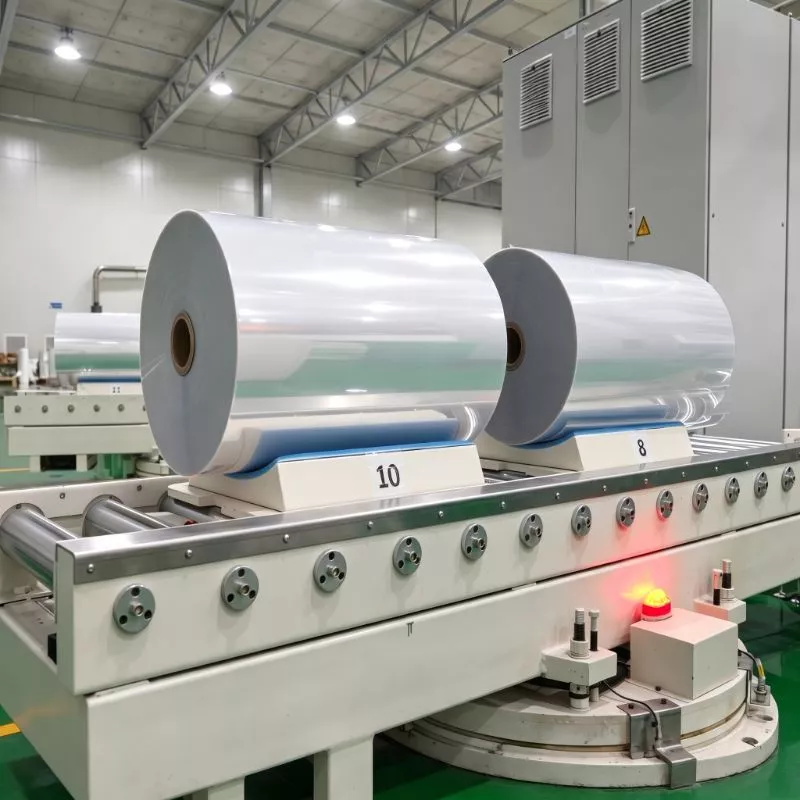
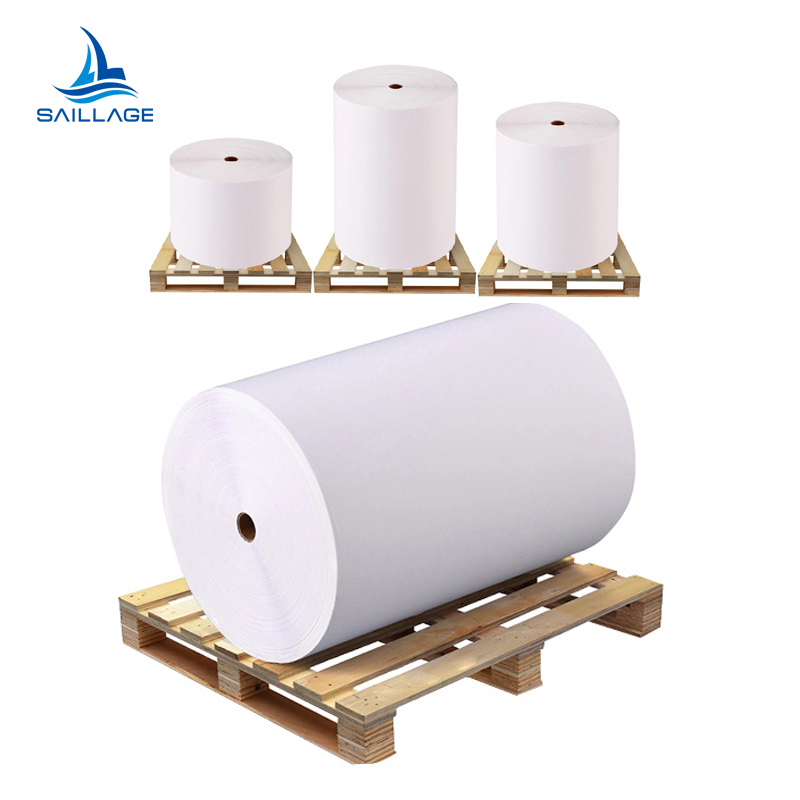
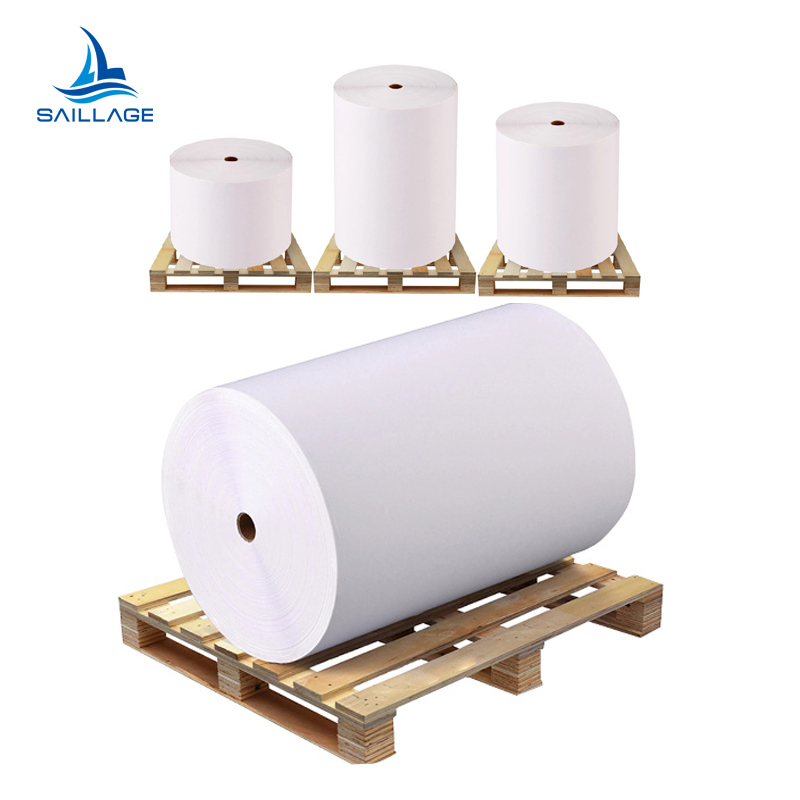
A master roll is a production input, so procurement teams should verify more than width, thickness, and price. Request a current technical data sheet, lot-specific quality records where available, TD and MD shrink curves, recommended processing conditions, and storage guidance. Confirm whether the stated shrink values are typical or guaranteed specifications and whether the supplier’s test conditions match the converter’s evaluation method. For repeat orders, define the acceptable range for shrink behavior and agree on how changes between lots will be assessed.
Warehouse handling matters because roll condition can affect downstream converting. Protect rolls from contamination, edge damage, excessive pressure, and temperature or humidity conditions outside the supplier’s recommendations. Allow material to condition to the production environment when advised by the supplier. Use first-in, first-out stock rotation where practical, and retain roll identification and lot traceability so defects can be linked to a specific batch. Storage guidance should come from the actual supplier’s documentation rather than a generic temperature rule.
5. Compare a conventional selection approach with curve-led selection
The table below contrasts a common specification-led purchasing approach with a curve-led qualification approach. The benefits are process goals, not guaranteed numerical improvements; results should be confirmed through line trials because bottle design, printing, tunnel configuration, and line speed vary.
Traditional vs Curve-Led Selection
| Selection dimension | Specification-led approach | Curve-led recommendation |
|---|---|---|
| Primary selection basis | Choose by “high” or “medium” shrink label and price | Review TD and MD curves at relevant temperatures and stated test conditions |
| Bottle geometry | Use a broad category such as beverage or cosmetic bottle | Map the bottle’s maximum/minimum circumference, shoulders, waist, base and neck |
| Tunnel setup | Adjust heat until visible defects reduce | Qualify film at normal speed and at realistic operating-window limits |
| Artwork and registration | Approve printed artwork before full line validation | Check graphic distortion and MD movement on the actual container |
| Supplier comparison | Compare headline maximum shrink values | Compare equivalent test methods, shrink onset, curve slope and plateau behavior |
| Quality and repeatability | Check each delivery mainly for dimensions and appearance | Set agreed shrink acceptance ranges, retain lot data and investigate trend changes |
Practical Selection Checklist
Use the following checklist before approving a High Shrink PETG Film roll, Medium Shrink PETG Film, or low shrink PETG film for production:
Define the package geometry. Obtain container drawings or reliable measurements. Identify the largest and smallest circumferences, shoulder angle, waist, base transition, neck and any recessed features.
Request the complete TD/MD shrink curve. Ask for data at multiple temperatures, the test method, exposure time, and clarification of whether values are typical or specification limits.
Match shrink demand to film capability. Estimate the circumferential change required by the container and assess TD performance at the actual process temperature. Check MD shrink against sleeve height, seam position and artwork registration.
Review the complete converting route. Include printing, ink curing, slitting, seaming, sleeve application and tunnel heating. Film performance cannot be separated from these process stages.
Run a controlled line trial. Keep a record of tunnel-zone settings, line speed, bottle type, sleeve dimensions and observed defects. Change one variable at a time where possible, so the cause of improvement or failure remains clear.
Set acceptance criteria with the supplier. Define critical dimensions, shrink ranges, appearance requirements, roll identification, sampling frequency and the procedure for handling nonconforming lots.
Approve production at realistic limits. A film that works only at one narrow setting may be risky for a high-volume line. Check performance at the expected range of line speed, ambient conditions and container variation.

FAQ: Common Questions from Buyers and Converters
Is High Shrink PETG Film always better for full-body labels?
No. High shrink is useful when the sleeve must follow pronounced contours, but a higher maximum value alone does not guarantee smooth coverage. The curve shape, MD shrink, artwork distortion, tunnel control and container geometry all matter. Qualify the film on the intended package.
Can I compare shrink percentages from two suppliers directly?
Only when the test conditions and methods are comparable. Temperature, exposure time, specimen preparation and test medium can change the result. Request the full TD/MD curves and test details rather than comparing one maximum-shrink number.
What should I check if the sleeve wrinkles near the bottle base?
Check whether the film is mismatched to the base geometry, whether sleeve dimensions and seam quality are consistent, and whether heat distribution or residence time is uneven. Review TD and MD behavior and inspect the defect at more than one tunnel setting before changing several variables at once.
Should procurement prioritize shrink percentage or price per kilogram?
Neither should be considered alone. Compare the cost of usable sleeves, line speed, start-up waste, defect rate and consistency between lots. A lower-priced roll can become more expensive if it requires a narrow process window or generates more rejects. Confirm the economics with a controlled trial.
Conclusion & B2B Action Guide
Selecting between High Shrink PETG Film and Medium Shrink PETG Film is a package-engineering decision, not a label-based purchasing shortcut. TD shrink helps determine circumferential conformity, while MD shrink affects sleeve height and registration. Shrink onset, curve slope and plateau behavior must be read together with bottle geometry, artwork requirements and tunnel conditions. For repeatable production, use comparable test data, trial the film on the intended line, and agree on measurable acceptance criteria with the supplier.
Before placing a master-roll order, share the container drawing, target sleeve dimensions, line speed, tunnel profile and application requirements with your PETG film supplier or process engineer. Request the current TDS and TD/MD shrink curves, then arrange a sample-roll trial. This gives procurement, converting and R&D teams a common technical basis for selecting a film that fits the package and the production process.





contact
Tel: +86 17706217416
Add: Building L2A, No. 520, Lane 1588, Zhuguang Road, Hongqiao World Center, Qingpu District, Shanghai, China
follow us: