
 English EN
 French FR
 German DE
 Portuguese PT
 Spanish ES
 Russian RU
 Japanese JA
 Korean KO
 Arabic AR
 Greek EL
 Turkish TR
 Italian IT
 Polish PL
 Hindi HI
 中国 CN
中国 CN
.webp)
Shrink Film vs BOPP Overwrap | Packaging Film Guide
Introduction
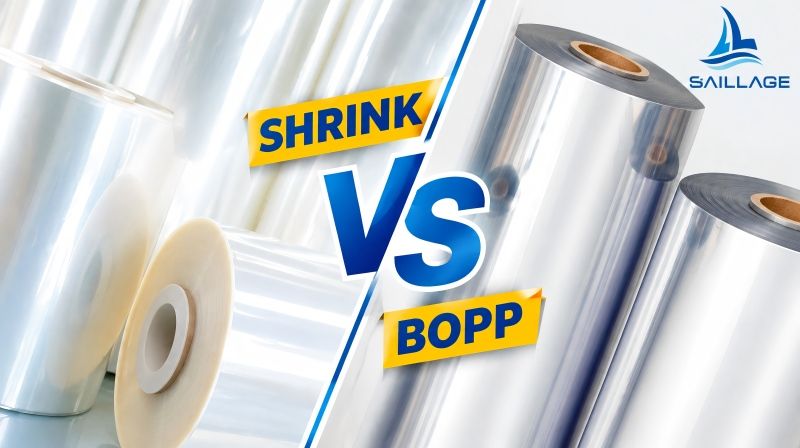
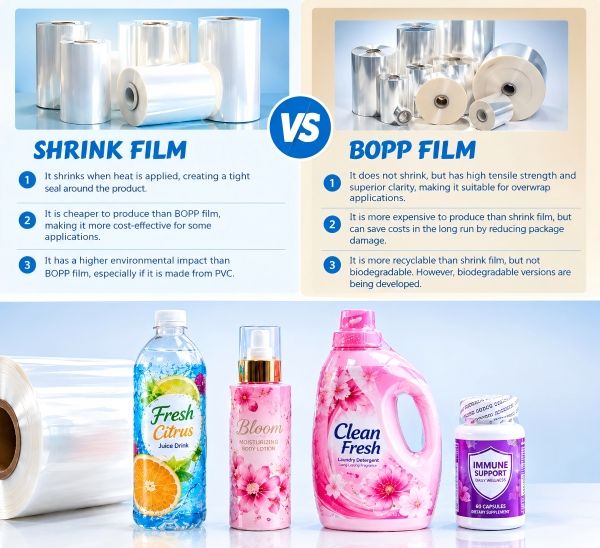
Packaging buyers frequently compare Shrink Film vs BOPP Film when selecting an overwrap for cartons, cosmetic boxes, and multipacks. The two structures solve different packaging problems. Shrink film is designed to contract around a product when exposed to controlled heat, while BOPP overwrap is generally selected for stable web handling, optical appearance, printability, and controlled wrapping behavior. Choosing between them affects machine speed, package appearance, material consumption, sealing performance, and the final cost per packed unit.
The decision becomes more technical when shrink level, product geometry, film gauge, sealing system, and print construction are considered. PETG films are another important category for full-body shrink sleeves, but they should not be treated as a direct substitute for overwrap film. Heat-shrink PETG film and PETG heat-shrink film are engineered for sleeve applications where circumferential shrinkage creates a conformable label around a container.
Key Takeaways
Shrink film is appropriate when controlled thermal contraction is needed to conform film around boxes, products, or multipacks.
BOPP overwrap is appropriate when dimensional stability, high-speed web handling, print appearance, and controlled wrapping are more important than strong shrink conformity.
PETG films are primarily relevant to shrink sleeves, where shrink direction and shrink curve must match container geometry.
The most suitable shrink films depend on required shrinkage, sealing temperature, package shape, machine speed, and appearance requirements.
Film selection should be based on total packaging cost and line performance rather than film price per kilogram alone.
Technical Core: Shrink Film, BOPP Overwrap and PETG Sleeve Film
Shrink film is a polymer film manufactured and oriented so that it can contract when heated. During packaging, the film is wrapped or sleeved around the product and passed through a controlled heating zone. Stored orientation energy is released, causing dimensional contraction. The resulting package can have a close-fitting appearance and can help hold grouped products together.
BOPP is biaxially oriented polypropylene. The film is stretched in both machine direction (MD) and transverse direction (TD), producing a dimensionally stable substrate with useful stiffness, clarity, and tensile performance. BOPP overwrap normally relies on controlled wrapping, folding, and sealing rather than large thermal contraction. A cosmetic bopp film can therefore be designed for premium graphics and surface appearance without depending on a strong shrink effect.
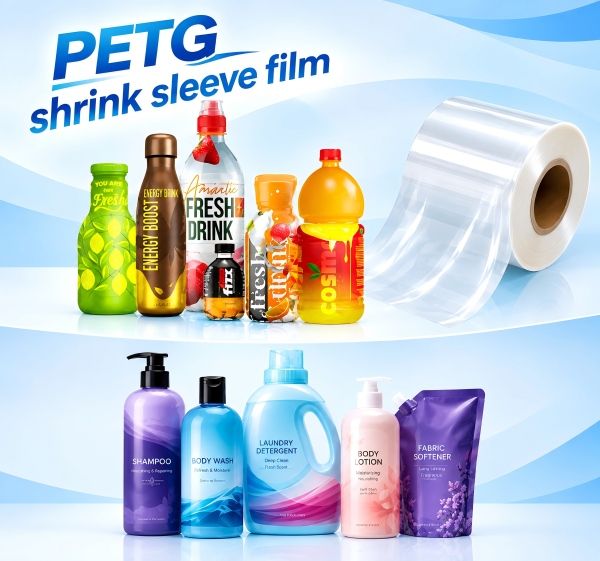
PETG is polyethylene terephthalate glycol-modified polymer. PETG films are widely used for shrink sleeves because the film can be engineered for substantial circumferential shrinkage. A High Shrink Rate PETG Shrink Sleeve Film is selected when the sleeve must conform around containers with pronounced contours. A Medium Shrink Rate PETG Shrink Sleeve Film is more appropriate where moderate contraction is required.
The critical technical variables are shrinkage by direction, shrink-force behavior, film thickness, seal performance, COF, haze/gloss, and dimensional stability. Shrink percentage must always be interpreted with its test temperature, direction, and method. A film with a high nominal shrink rate is not automatically the best choice if the package or sleeve has only modest dimensional variation.
Application & Solutions
1. Carton and Box Overwrap
For individual cartons, selection depends on whether the package needs a tight shrink fit or a stable, controlled overwrap. Shrink film is useful when the film should conform closely to the carton and minimize loose material around corners. BOPP overwrap can be advantageous where optical clarity, graphics, and predictable web behavior are priorities. The packaging line must be considered with the film because shrink systems add a controlled heating stage.
☑ Measure carton length, width, height, corner geometry, and required overlap before selecting film width.
☑ Define wrapping speed and sealing method.
☑ For shrink film, establish required MD and TD shrinkage and validate the package after heating.
☑ For BOPP, check COF, stiffness, fold behavior, and seal compatibility with the actual machine.
☑ Compare finished-package appearance and material consumption at production speed.
2. Cosmetics: Premium Appearance vs Conformability
Cosmetic packaging places unusual emphasis on visual quality. Transparent films, high gloss, matte surfaces, precise graphics, and clean edges can influence perceived product value. BOPP films for premium cosmetic lables & package are commonly considered when the label or overwrap requires a stable, printable film surface and attractive optical performance.
Shrink film becomes more useful when packaging needs a close-fitting protective wrap around an irregular box or container. PETG sleeve film is a different solution again: it is intended to conform around the entire body of a container and can provide 360-degree graphics.
A Heat shrink PET-G sleeve film should be selected according to container geometry and shrink curve. Excessive shrink capability can create distortion, while insufficient shrinkage can leave wrinkles or an incomplete fit.
3. Multipacks and Group Packaging
Multipack packaging requires film to maintain tension around a group of products during handling, transport, and retail display. Shrink film can create a tight bundle after heating and is useful when package consolidation is a primary objective. BOPP overwrap is better suited to situations where the group package needs a stable overwrap with controlled appearance and predictable web handling.
Define the number and arrangement of products in the multipack.
Check whether product corners can puncture or stress the film during shrinking.
Evaluate package rigidity after cooling and during manual handling.
Compare film consumption per multipack rather than nominal film prices.
Monitor seal integrity and film breakage at the highest planned production speed.
4. Full-Body Shrink Sleeves: PETG Selection
For full-body sleeves, PETG films are generally evaluated by their shrink curve rather than generic shrink-film performance. A High Shrinkage Transparent Petg Shrink Film can accommodate containers with significant shape changes, while a Medium Shrink Rate PETG Shrink Sleeve Film can provide more moderate conformity.
The most suitable shrink films for a sleeve application should match maximum diameter change, shoulder and neck geometry, label height, and required distortion control. The printer and seaming process also matter because the sleeve must maintain registration and print appearance through shrinking.
☑ Obtain shrink curve or shrinkage data by temperature and direction.
☑ Map the container profile before choosing a shrink grade.
☑ Verify transverse shrinkage against the sleeve circumference requirement.
☑ Check print registration and graphic distortion after shrinking.
☑ Validate sleeve seaming, application, and tunnel conditions on production equipment.
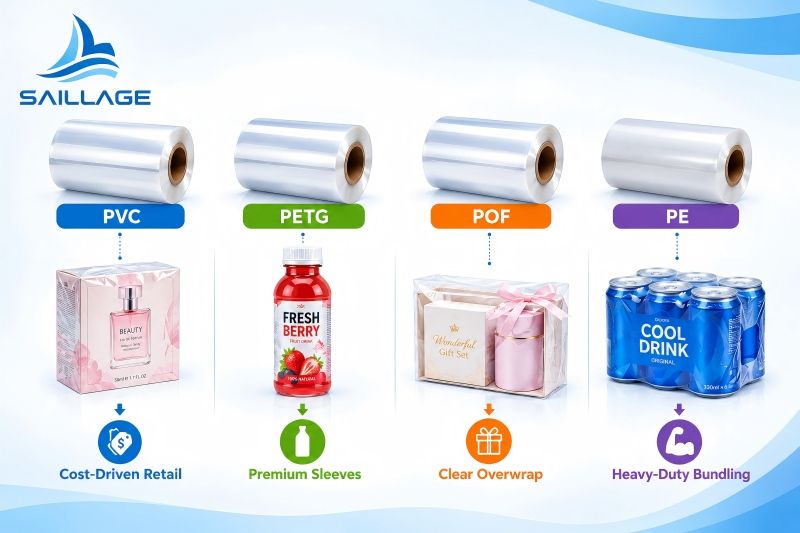
5. Comparing the Main Film Options
| Factor | Shrink Film | BOPP Overwrap | PETG Sleeve Film | Selection Logic |
|---|---|---|---|---|
| Primary function | Thermal contraction around product | Stable overwrap and printed surface | High-conformity shrink sleeve | Start with required package geometry |
| Shrink behavior | Engineered thermal shrinkage | Normally limited compared with shrink films | High circumferential shrinkage | Match shrink curve to package/sleeve profile |
| Typical use | Boxes, bundles, multipacks | Cartons, premium overwraps, labels | Full/partial body sleeves | Choose according to package architecture |
| Process | Wrapping + controlled heating | Wrapping/folding/sealing | Printing + seaming + sleeve application + tunnel | Check complete line requirements |
| Appearance | Tight, conforming finish | Stable, clean, printable overwrap | 360-degree graphics possible | Evaluate after actual processing |
| Cost drivers | Film, heat energy, speed, scrap | Film, converting, sealing | Film, printing, seaming, application, tunnel | Use total cost per finished unit |
6. How to Select the Most Suitable Shrink Films
There is no single shrink-film grade that is optimal for every package. The most suitable shrink films are selected by matching material behavior to the actual production window.
☑ Define shrinkage target by direction and test condition.
☑ Determine film gauge from package weight, puncture risk, and machine handling.
☑ Check seal initiation temperature and sealing window.
☑ Evaluate shrink force and final package tension where product integrity is important.
☑ Confirm optical requirements such as haze, gloss, and transparency.
☑ Test COF and blocking because they affect feeding, stacking, and rewinding.
☑ Run production trials at minimum, nominal, and maximum machine speeds.
7. B2B Procurement and Total Cost of Ownership
For a warehouse manager, purchasing manager, category manager, CEO, or commercial director, the relevant purchasing metric is the cost of an acceptable finished package. A lower film price can be offset by higher scrap, slower machine speed, greater heat consumption, poor sealing, or package appearance problems.
PETG films distributors should additionally consider film gauge, shrink curve, printability, seaming behavior, and container compatibility. BOPP film distributors and converters should focus on film thickness, surface treatment, COF, optical properties, winding quality, and converting performance.
Compare film consumption per 1,000 finished packages.
Record line speed, scrap percentage, downtime, and sealing defects during trials.
Include heating energy when comparing shrink-film structures.
Separate film performance from machine capability when diagnosing production problems.
Qualify more than one supplier when supply continuity is commercially important.
FAQ
What is the main difference between Shrink Film vs BOPP Film?
Shrink film is engineered to contract when heated, while BOPP overwrap is biaxially oriented polypropylene designed primarily for stable web handling, printability, stiffness, and controlled wrapping. The right option depends on whether thermal conformity is a core requirement.
When should I use PETG films instead of shrink overwrap film?
PETG films are generally considered when a full or partial body shrink sleeve is required. Their shrink behavior can conform closely to container contours. They are not simply a higher-shrink substitute for every box or multipack overwrap.
How do I choose between High Shrink Rate PETG Shrink Sleeve Film and Medium Shrink Rate PETG Shrink Sleeve Film?
Map the container profile first. High shrink rate grades are useful for containers with greater circumferential variation, while medium shrink rate grades can be preferable when moderate conformity and lower graphic distortion are required. Always compare the actual shrink curve, not only the headline shrink percentage.
Is cosmetic BOPP film suitable for premium cosmetic packaging?
Yes, when the package requires a stable printable film surface, attractive clarity or gloss, and controlled converting behavior. BOPP films for premium cosmetic lables & package should be qualified with the actual ink, adhesive, printing method, and packaging machine.
Conclusion & CTA
Shrink film, BOPP overwrap, and PETG sleeve film each address a different packaging requirement. Shrink film provides thermal conformity, BOPP provides stable and printable overwrap performance, and PETG shrink sleeve film provides high circumferential shrinkage for contoured containers.
For B2B buyers, the most reliable selection process is to define package geometry, required shrink behavior, machine conditions, appearance targets, and total cost per finished unit before approving a film grade. PETG films distributor, BOPP film distributor, and converter teams should validate candidate films through controlled production trials.
For technical evaluation, request film samples together with thickness, shrinkage data, sealing information, optical properties, and recommended processing conditions. A supplier's engineering team can then help match the film structure to the specific box, cosmetic package, multipack, or shrink-sleeve application.




News & Events
learn more-
 Blog
Press Release Sep-17-2026
Blog
Press Release Sep-17-2026BOPP Film Coatings Explained: Acrylic, PVdC, Heat-Seal and Top-Coated Grades
Compare acrylic, PVdC, heat-seal and top-coated BOPP film grades by printability, barrier performance, sealing behavior and converting requirements. -
 Blog
Press Release Sep-17-2026
Blog
Press Release Sep-17-2026BOPP Label Material vs Vinyl vs Paper: Which Label Facestock Should Your Product Use?
Compare BOPP label material, vinyl, and paper facestocks by moisture resistance, printability, durability, cost, and applications to choose the right label. -
 Blog
Press Release Sep-17-2026
Blog
Press Release Sep-17-2026How to Read a BOPP Film Technical Data Sheet: Thickness Tolerance, COF, Haze, Gloss, Tensile and Shrinkage
How to read a BOPP film technical data sheet: thickness tolerance, COF, haze, gloss, tensile strength, elongation and shrinkage explained for converters and buyers.

contact
Tel: +86 17706217416
Add: Building L2A, No. 520, Lane 1588, Zhuguang Road, Hongqiao World Center, Qingpu District, Shanghai, China
follow us: