
 English EN
 French FR
 German DE
 Portuguese PT
 Spanish ES
 Russian RU
 Japanese JA
 Korean KO
 Arabic AR
 Greek EL
 Turkish TR
 Italian IT
 Polish PL
 Hindi HI
 中国 CN

.webp)
How to Qualify a PETG Shrink Film Supplier: TDS, Samples and Batch Acceptance
Introduction
A supplier’s brochure may describe a PETG shrink film as suitable for sleeve labels, but a successful commercial qualification requires more than a product description. Converters can face print defects, unstable shrink behaviour, roll damage, or batch variation even when the material appears acceptable during a short initial trial. A structured petg shrink film supplier evaluation should therefore connect the supplier’s technical documentation to sample testing and repeatable batch acceptance.
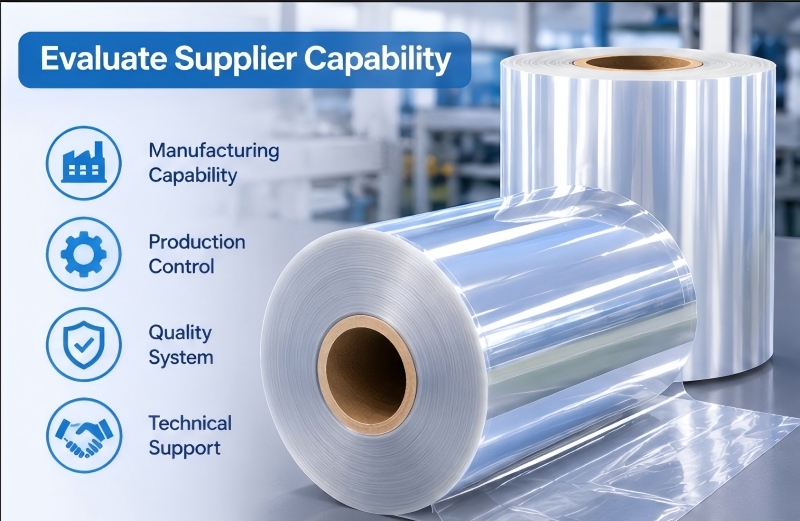
For procurement teams, the key question is not simply whether a supplier can offer a High Shrink PET-G Film roll or Medium Shrink PETG Film. It is whether the supplier can consistently deliver the agreed grade, document its properties, maintain traceability, and support the converter when production conditions change. This applies to a PETG Shrink Film Master Roll factory, a distributor, and a heat shrink PETG sleeve lable film supplier.
Key Takeaways
assess technical capability and process control
review the TDS for relevant properties and test conditions
conduct application-specific sample trials
define lot-level acceptance criteria
and establish a documented change-control and complaint process before repeat orders
Technical Core: TDS, Samples and Batch Acceptance
PETG (polyethylene terephthalate glycol-modified) is a copolyester used in shrink sleeve films. During film manufacture, orientation creates molecular alignment. When heated, the oriented film relaxes and contracts, producing thermal shrinkage. Final sleeve performance depends on film grade, shrink profile, container geometry, printing, seaming, and shrink-tunnel conditions. Supplier qualification must evaluate the material as part of the converting system, not as an isolated roll.
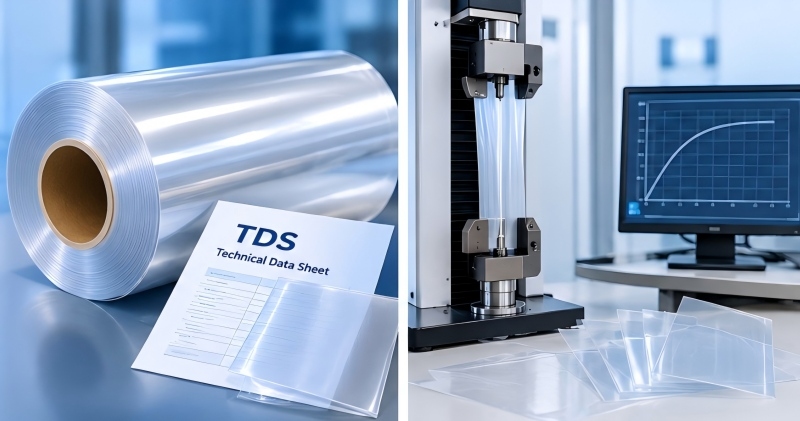
A technical data sheet (TDS) is a grade-level document describing selected properties and recommended conditions. It is useful for screening suppliers, but it should not automatically be treated as a lot-specific quality certificate. Review the TDS for thickness, width options, TD (transverse direction) and MD (machine direction) shrinkage, test conditions, optical appearance, surface or printability information where provided, and storage or handling guidance. Shrinkage values are meaningful only when test temperature, exposure time, method, and direction are clear. Commercial labels such as High Shrink PET-G Film roll or Medium Shrink PETG Film are not universal technical classifications; compare actual data rather than grade names alone.
Samples establish whether the grade works on the customer’s equipment. A laboratory sample can help assess basic properties, while a production-representative roll is needed to evaluate web handling, print registration, ink adhesion, seaming, sleeve forming, and tunnel performance. Sample approval should record film lot, press and ink system, operating settings, container, shrink equipment, test date, and acceptance criteria. Without this information, a successful trial may be difficult to reproduce.
Batch acceptance is the process of deciding whether a delivered lot meets the agreed purchase specification. It should distinguish routine incoming checks from properties requiring laboratory testing or supplier documentation. Roll labels, master-roll and slit-roll traceability, lot numbers, inspection records, and change notifications support consistent decisions. A supplier’s capability is demonstrated not only by a good first sample, but by the ability to repeat approved performance across subsequent deliveries.
Application & Solutions: A Practical Supplier Qualification Workflow
1. Screen the supplier’s technical and operational capability.
Ask whether the supplier manufactures film, converts master rolls, or acts as a distributor. Clarify which operations are performed in-house and which are subcontracted. For a China manufacturer for high shrink PET-G film jumbo roll, confirm the manufacturing and export entity, production location, product scope, and role of any trading company. A supplier for high performance PETG shrink film master roll should explain its grade range, production control, slitting capability, and technical support boundaries.
Review production capacity and continuity without relying only on general claims. Discuss typical order quantities, lead times, available widths and gauges, stock policy, and urgent replenishment. If a petg shrink film supplier with parent PETG film roll in stock is important, clarify whether stock is reserved, how it is identified by lot, and whether its specification matches the approved grade. Stock availability does not replace quality qualification.
2. Evaluate the TDS and supporting documents.
Request a current TDS for the exact grade. Confirm that the product name and revision are identifiable and that stated properties match the intended sleeve application. Ask for a sample inspection report or certificate of analysis where available, and identify which parameters are tested for each lot. Do not assume a document includes results that are not explicitly listed.
Check whether shrinkage data is reported in both TD and MD and whether test conditions are disclosed. Review thickness and width tolerances, print-side or treatment information, and storage conditions. If the TDS leaves a critical item unspecified, record it as an open technical question and obtain written clarification before sample approval.
3. Run a controlled sample trial.
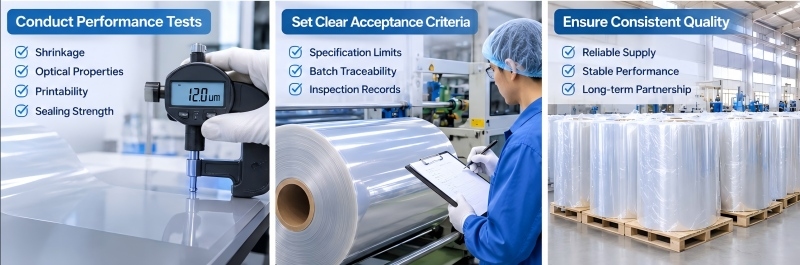
Use the same container, artwork, ink system, printing process, sleeve-seaming method, and shrink tunnel settings when comparing suppliers. Record actual conditions. Evaluate print quality, surface wetting, ink adhesion, scuff resistance, sleeve fit, wrinkles, bridging, distortion, seam integrity, and web handling. Define the trial scope with production and R&D teams.
Label the sample roll with supplier, grade, thickness, width, lot number, and date received.
Keep a retained sample or documented reference where practical.
Record press, ink, drying or curing, seaming, tunnel temperature, conveyor speed, and container details.
Agree on pass/fail criteria before the trial, including defect measurement and approval responsibility.
Separate material-related observations from process-setting issues and repeat a trial when the cause is uncertain.
4. Define incoming batch acceptance.
Create a purchase specification stating parameters to be checked, method or document used, and response if a result falls outside the agreed limit. Routine checks may include packaging integrity, roll identification, width, thickness where measured, edge condition, winding quality, and visible contamination. Shrink behaviour, surface properties, or ink performance may require agreed testing, supplier records, or periodic verification rather than inspection of every roll.
Set a sampling frequency appropriate to order size, risk, and supplier history. The sampling plan should be mutually agreed; do not invent a universal sample size or tolerance. Define how nonconforming rolls are segregated, how the supplier is notified, how investigation is performed, and whether replacement, credit, rework, or concession approval is possible. Maintain records linking complaints to roll IDs and production lots.
5. Monitor performance after approval.
Qualification is not a one-time event. Track repeat-order results such as delivery reliability, roll defects, line stoppages, print or shrink complaints, response time, and corrective-action effectiveness. Review trends by supplier, grade, and lot. Requalification may be appropriate after a major formulation, production-line, raw-material, coating, or slitting change, or when repeated performance falls outside the approved range. Ask the supplier to notify you of changes that could affect the agreed specification.
6. Compare suppliers using risk and total cost.
Purchase price is only one part of supplier value. Consider material yield, setup waste, line speed, downtime, rejected sleeves, inspection burden, freight, inventory availability, and technical responsiveness. A lower-cost roll that causes repeated adjustment or scrap can increase total conversion cost. Use the same specification and trial protocol for each candidate supplier so the comparison is fair and technically meaningful.
Traditional vs. Structured Supplier Qualification
| Qualification area | Traditional approach | Recommended structured approach |
|---|---|---|
| Supplier capability | Rely on company profile and sales claims | Verify manufacturing role, site, process scope, and technical support |
| TDS review | Compare headline shrink percentage or grade name | Check actual TD/MD values, test conditions, tolerances, and document revision |
| Sample approval | Run an informal press trial | Use defined conditions, acceptance criteria, recorded results, and sample traceability |
| Batch acceptance | Inspect only visible roll defects | Combine agreed incoming checks, lot records, and risk-based verification |
| Supplier monitoring | Approve once and reorder automatically | Track repeat performance, complaints, changes, and corrective actions |
| Cost comparison | Choose lowest quoted price | Assess yield, waste, downtime, logistics, and technical service |
RFQ and Supplier Audit Checklist
Supplier identity: legal manufacturing entity, production site, manufacturer/distributor role, and subcontracted operations.
Product definition: exact PETG grade, intended application, nominal thickness, width, and shrink profile.
TDS: revision date, test methods and conditions, TD/MD shrink data, dimensional tolerances, and handling guidance.
Lot documentation: roll labels, lot number, traceability, and agreed inspection report or certificate of analysis.
Sample trial: sample quantity, production conditions, evaluation criteria, approval personnel, and retained reference.
Batch acceptance: incoming checks, sampling frequency, test responsibilities, nonconformance process, and disposition rules.
Change control: advance notification of changes to material, process, site, or specification that may affect performance.
Commercial and logistics: lead time, MOQ, stock policy, packaging, delivery terms, and replenishment plan.
Technical support: response channel, complaint investigation, corrective-action documentation, and escalation contacts.
Use this checklist to make supplier responses comparable. Where a supplier cannot provide a requested item, record the gap and decide whether it is acceptable for the intended application rather than treating missing information as confirmed compliance.
FAQ
Is a TDS enough to approve a PETG shrink film supplier?
No. A TDS supports grade screening, but it does not prove that a particular shipment meets the agreed specification. Combine document review, application-specific sample trials, and lot-level acceptance records.
Should every batch be tested in the laboratory?
Not necessarily. Define critical properties, supplier lot documentation, incoming inspection, and periodic verification based on risk and performance history. The plan should be agreed by supplier and customer rather than based on an assumed universal frequency.
What is the most reliable way to compare two PETG film suppliers?
Send both suppliers the same technical specification and evaluate samples under the same press, ink, container, seaming, and shrink conditions. Compare quality, process stability, traceability, service, and total conversion cost, not price alone.
When should an approved supplier be requalified?
Review qualification after material or process changes, production-site changes, significant complaints, recurring batch deviations, or a change in the customer’s application. Define notification and reapproval requirements in the supplier quality agreement or purchase specification.
Conclusion & B2B Action Guide
A reliable PETG shrink film supplier is qualified through evidence: a clear TDS, representative samples, reproducible converting results, traceable batches, and an agreed response to nonconformities. Procurement, engineering, quality, production, and warehouse teams should use one shared specification so supplier approval is based on performance rather than assumptions or sales descriptions.
Before your next sourcing decision, prepare application requirements and acceptance criteria, request the exact-grade TDS, and arrange a controlled sample trial. Ask shortlisted suppliers to explain lot traceability, change-control, and complaint-handling procedures. Contact the supplier’s technical team to review the specification or request samples for qualification before committing to repeat commercial orders.




News & Events
learn more-
 Blog
Press Release Nov-13-2026
A Guide to DTF Film Peeling: Cold, Hot, Instant and All-Time
Compare Cold, Hot, Instant and All-Time Peel DTF films by release timing, transfer quality, workflow, pressing conditions and production applications. -
 Blog
Press Release Nov-13-2026
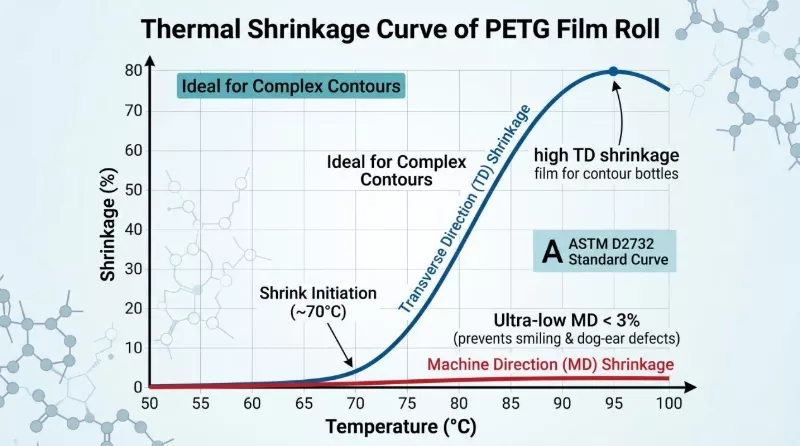
PETG Film Roll: Prevent Dog-Ears on Contour Bottles h1: High-Shrink PETG vs. Complex Bottle Contours: Defect Prevention
Master high TD shrinkage film for contour bottles to eliminate dog-ears and smiling effects. Increase yield by 15% with optimized PETG film roll selection. -
 Blog
Press Release Nov-13-2026
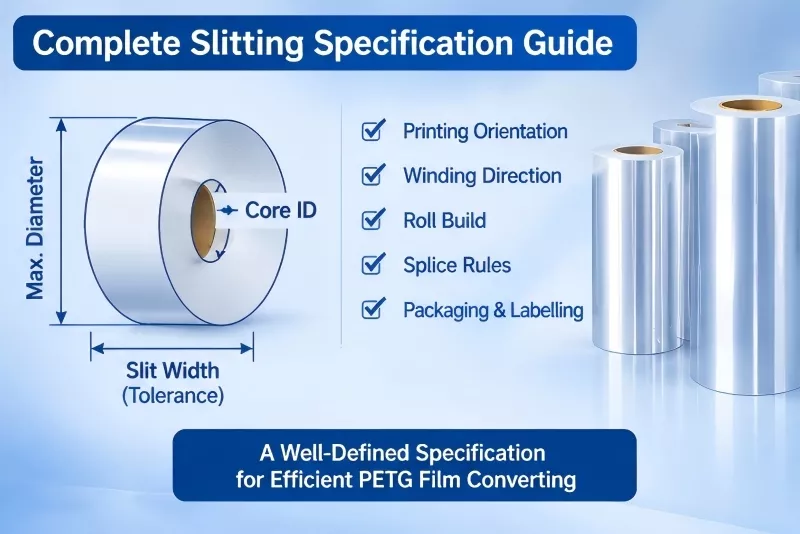
Slitting PETG Shrink Film Master Rolls: Winding Direction, Roll Build and Splice Specs
Learn how to specify PETG shrink film slitting, including winding direction, roll build, splice control, slit-roll dimensions, traceability and line qualification.

contact
Tel: +86 17706217416
Add: Building L2A, No. 520, Lane 1588, Zhuguang Road, Hongqiao World Center, Qingpu District, Shanghai, China
follow us: