
 English EN
 French FR
 German DE
 Portuguese PT
 Spanish ES
 Russian RU
 Japanese JA
 Korean KO
 Arabic AR
 Greek EL
 Turkish TR
 Italian IT
 Polish PL
 Hindi HI
 中国 CN

.webp)
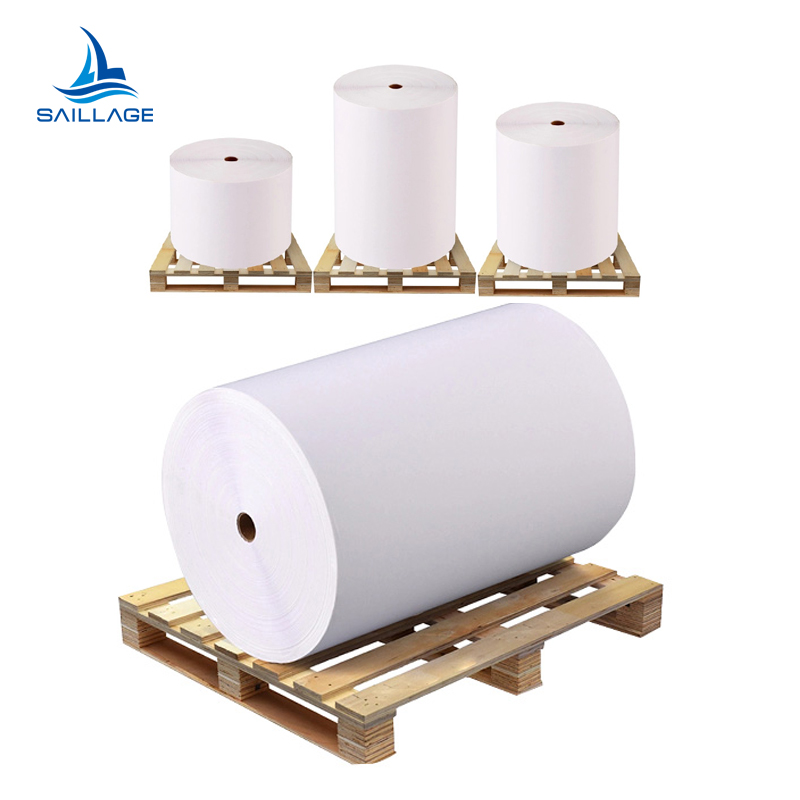
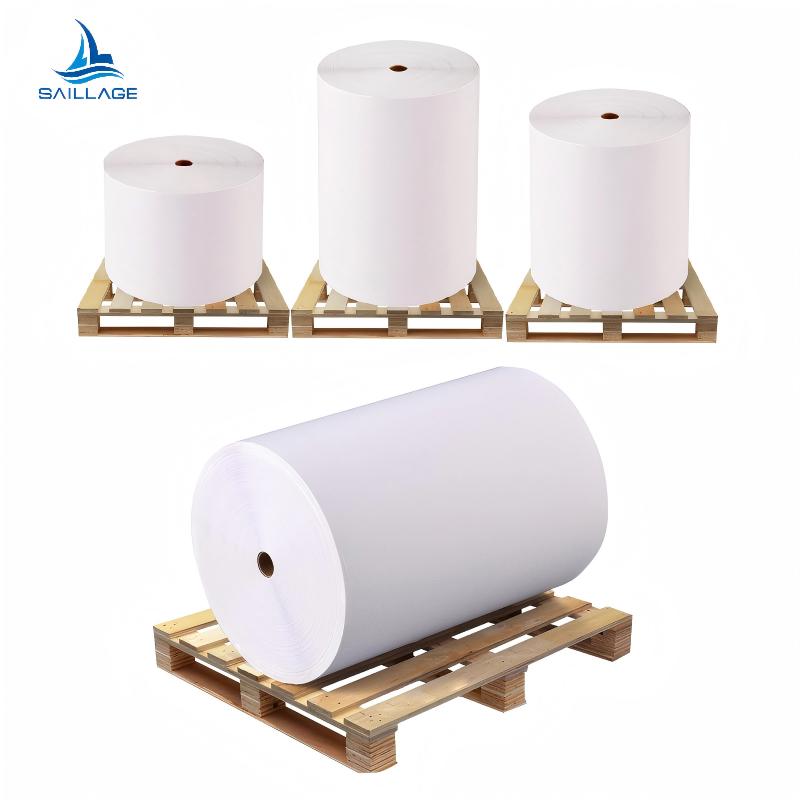
Slitting PETG Shrink Film Master Rolls: Winding Direction, Roll Build and Splice Specs
Introduction
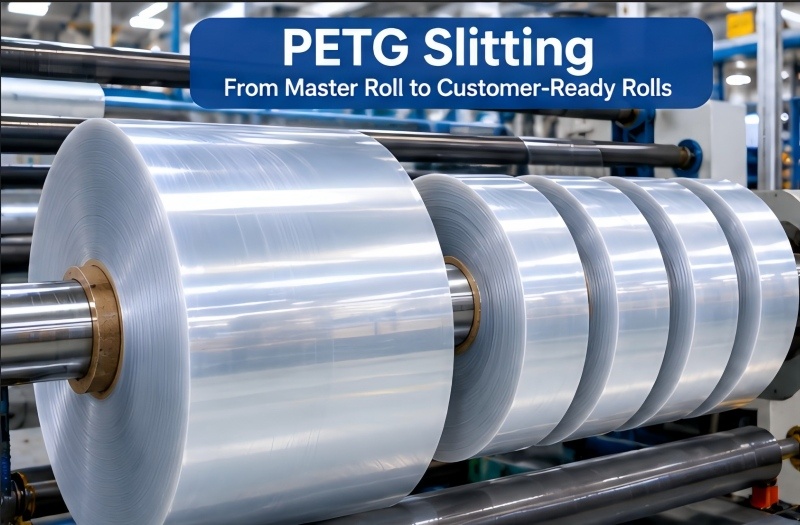
Slitting PETG shrink film master rolls into customer-ready rolls is not simply a width-reduction operation. A technically suitable master roll can still create downstream waste if winding direction is unclear, roll build is inconsistent, splice locations are poorly controlled, or slit rolls do not match the converter’s unwinding and sleeve-forming equipment. These issues may appear as web breaks, telescoping, edge damage, tracking instability, or unplanned press stops.
Slitting PETG Shrink Film Master Rolls requires coordinated specifications across film properties, slitter-rewinder configuration, roll geometry, and packaging. PETG shrink sleeve film is oriented to deliver heat-induced contraction, so converting teams must protect both the film’s dimensional behaviour and its physical integrity during slitting and rewinding. A petg jumbo roll slitting order should therefore define more than slit width and quantity.
Key Takeaways
confirm unwinding and printing orientation
define roll width, diameter, core, winding direction, and roll-build requirements
set clear splice rules and traceability
and validate the slit roll on the customer’s actual line. The objective is a stable, traceable roll that converts efficiently, not merely a master roll cut into smaller widths.
Technical Core: How Winding, Roll Build and Splices Affect PETG
PETG (polyethylene terephthalate glycol-modified) is a copolyester used in shrink sleeve films. Film orientation stores molecular alignment during manufacture; when heated, the oriented structure relaxes and the film shrinks. Slitting does not intentionally change the shrink mechanism, but it can introduce edge stress, tension variation, wrinkles, or damage that later affects printing and sleeve forming. Process control is therefore needed to preserve the master roll’s functional properties.
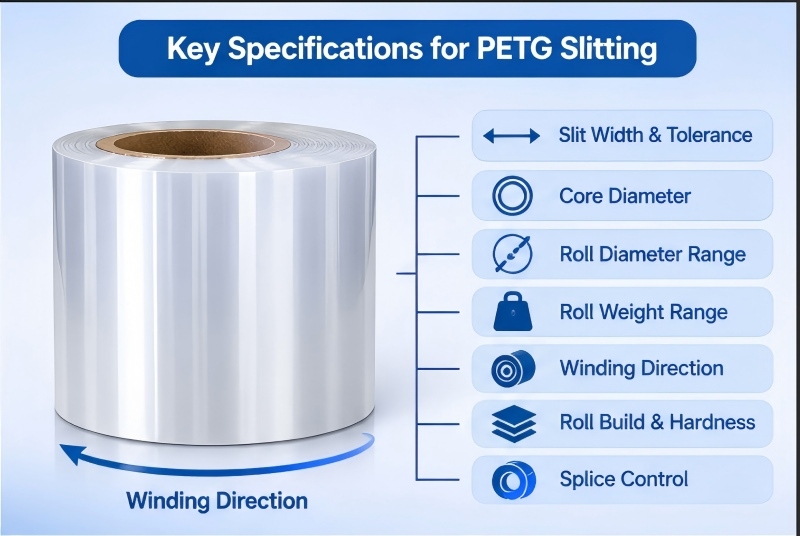
Winding direction describes how the film is wound and which surface faces inward or outward. It may be specified using a diagram, print-side orientation, or unwind direction from the operator’s viewpoint. Terms such as “inside wound” or “outside wound” can be interpreted differently across suppliers and equipment. A written specification should include a simple roll sketch and identify the print side, leading edge, and unwind direction. For transparent PETG shrink film wholesale for sleeve label printing, this prevents confusion when the film has no obvious visual distinction between surfaces.
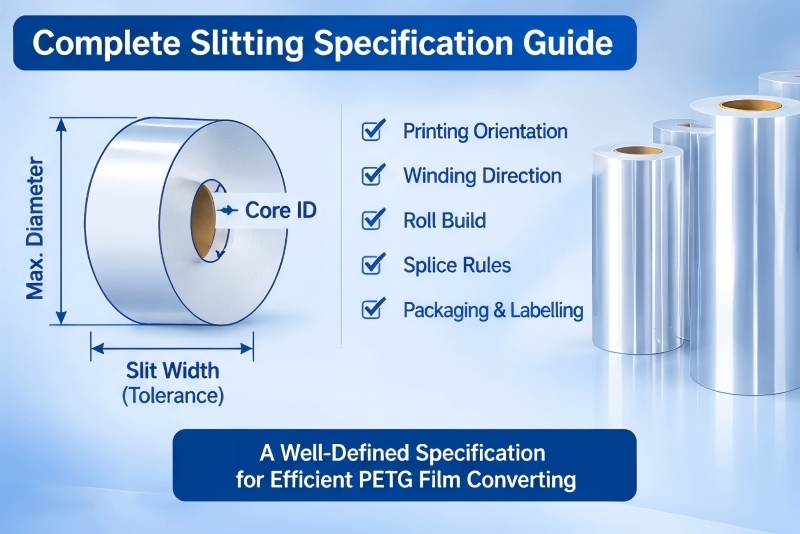
Roll build refers to the geometry and firmness of the wound roll. Relevant factors include roll diameter, core diameter, web tension, winding hardness, edge alignment, and consistency of the roll surface. A roll that is too soft may deform or telescope during handling; excessive or uneven tension can contribute to starring, wrinkles, blocking, or edge damage. The ideal winding profile depends on film thickness, width, roll diameter, slitter design, and downstream equipment. There is no single winding tension or hardness value suitable for every PETG grade and roll format.
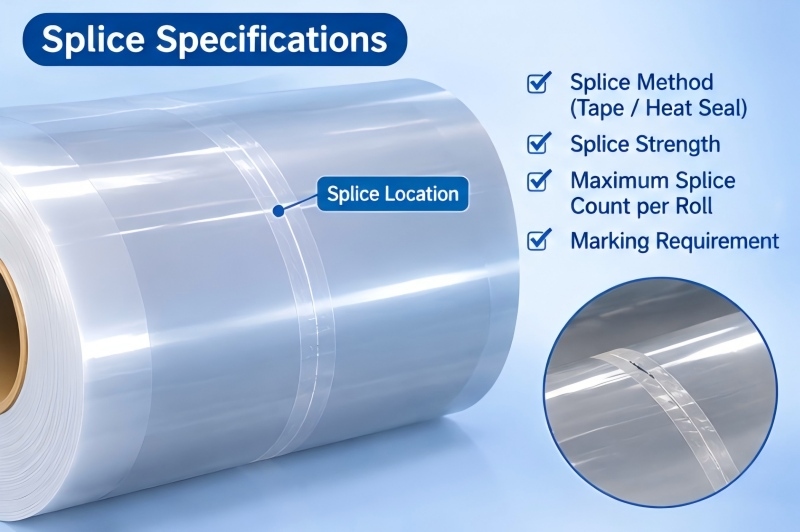
A splice joins two web sections when a master roll or slit roll contains a web discontinuity. Splices may be necessary for manufacturing or converting, but their location, tape type, thickness, strength, and visibility can affect downstream printing, inspection, sleeve seaming, and automatic splicing systems. Buyers should state whether splices are permitted, the maximum number per roll, preferred splice method, and whether splice flags or labels are required. Supplier capability and the converter’s process should determine the final limits.
PETG shrink films may include High Shrink PET-G Film roll, Medium Shrink PETG Film, and low shrink pet-g film grades. These commercial categories do not define a universal slitting setup. Film gauge, shrink profile, surface treatment, web width, and roll diameter should be considered together. A high-shrink grade intended for a petg shrink film jumbo roll for full-body shrink sleeve lables may require careful tension and handling control because the final sleeve design can be sensitive to wrinkles, edge defects, and print registration.
Application & Solutions: Slitting Specifications That Reduce Converting Risk
1. Confirm the customer’s unwind and printing orientation before production.
Obtain the customer’s press or sleeve-forming direction and identify the print side, unwind direction, and required leading edge. Do not rely on shorthand such as “clockwise” without a defined viewpoint. Include a labelled diagram in the purchase order or technical approval sheet. If the customer changes press configuration, re-confirm orientation before the next order.
2. Set roll dimensions and tolerances as a complete package.
Specify slit width and tolerance, core material and inside diameter, maximum and minimum roll diameter, roll weight range, winding direction, and any limits on roll-to-roll variation. State whether dimensions are measured before or after conditioning, if relevant to the agreed inspection method. Width tolerance should be linked to the customer’s web guide, printing layout, and sleeve size rather than copied from a generic specification.
3. Define roll-build acceptance criteria.
Discuss roll hardness or firmness using a supplier-customer agreed measurement or reference sample where possible. Include requirements for edge alignment, roll face appearance, telescoping, starring, wrinkles, loose winding, and core damage. For wide or large-diameter rolls, specify the acceptable edge profile and handling method. Avoid assigning a universal numeric hardness target unless both parties have agreed on the instrument, scale, measurement location, and test procedure.
4. Make splice control explicit.
Define the allowed number of splices per roll and whether splices are acceptable in customer-facing production. Specify the splice tape or joining method, splice orientation, maximum splice thickness if the customer has a validated limit, and marking method. A splice flag, roll label, or electronic record should identify the splice location so operators can anticipate it. If the customer’s press uses automatic splice detection or rejects spliced sections, communicate that requirement before slitting.
5. Protect shrink film during slitting and rewinding.
Use clean contact surfaces and suitable edge protection. Control web tension and slitting conditions to avoid stretching, edge nicks, dust, static-related contamination, and wrinkles. Inspect blades and slitting quality routinely; ragged edges or small notches can become initiation points for web breaks. Keep film wrapped when practical and minimize exposure to dust or handling damage between slitting, inspection, and packing. Establish settings through grade-specific trials rather than assuming they transfer from another film type.
6. Build lot-level traceability into every slit roll.
Each slit roll should carry a label linking it to the master roll and production lot. Include product grade, nominal thickness, slit width, roll number, net weight if required, winding direction, splice count or splice status, and production date or lot code. Keep a slitting record that captures the master-roll ID, slit-roll mapping, operator or line, inspection results, and deviations. This makes it possible to isolate affected rolls if a customer reports a converting issue.
7. Match packaging and warehouse handling to roll geometry.
Specify whether rolls are packed individually, on pallets, or in a customer-defined arrangement. Agree on core support, roll orientation, edge guards, wrapping, pallet stability, and label visibility. Avoid stacking or clamping methods that deform the roll face or core. Warehouse teams should follow the supplier’s storage guidance and protect rolls from moisture, dust, direct heat, and impact. Export packaging should withstand expected handling and transport without compromising roll shape.
8. Qualify the slit roll on the customer’s actual equipment.
Run representative rolls through the intended printing, slitting, sleeve-forming, or shrink process. Record web tracking, tension stability, splice handling, print registration, edge quality, and web breaks. When troubleshooting, change one major variable at a time. If film grade, press settings, splice design, and winding specification are all changed simultaneously, the root cause becomes difficult to isolate.
Traditional versus controlled slitting specification:
Traditional vs. Controlled Slitting Specification
| Specification area | Traditional / incomplete approach | Controlled recommendation |
|---|---|---|
| Winding direction | Use ambiguous “inside/outside” or clockwise wording | Provide labelled diagram with print side, leading edge and unwind viewpoint |
| Roll build | Accept by appearance alone | Define edge, winding firmness, defect criteria and agreed measurement method |
| Splices | Allow undocumented splices | Set splice count, method, marking and roll-level traceability |
| Quality approval | Inspect roll only at delivery | Combine incoming checks with representative line qualification |
| Troubleshooting | Change multiple settings at once | Record variables and isolate changes during trial runs |
RFQ and Slitting Checklist
☑ Film grade: PETG shrink sleeve film grade and shrink profile, including High Shrink PET-G Film roll, Medium Shrink PETG Film, or low shrink pet-g film designation where applicable.
☑ Master-roll information: master roll ID, nominal thickness, width, roll diameter, core size, and lot traceability.
☑ Slit-roll dimensions: target slit width and tolerance, core inside diameter, roll diameter or weight range, and quantity per width.
☑ Winding: unwind direction, print-side orientation, inside/outside wound definition, and a labelled roll diagram.
☑ Roll build: edge alignment, winding firmness or agreed hardness method, acceptable telescoping, starring, wrinkles, and core condition.
☑ Splices: permitted splice count, joining method or tape, splice position rules, splice flag/label, and traceability record.
☑ Inspection: sampling plan, visual criteria, dimensional checks, and procedure for handling nonconforming rolls.
☑ Packaging and logistics: individual or pallet packing, roll orientation, edge protection, label placement, storage guidance, and delivery conditions.
☑ Trial and approval: customer line test, acceptance criteria, approval owner, and change-control process.
A clear RFQ helps a PETG shrink film supplier or slitting partner identify technical details that affect cost and lead time. Any undefined item should be listed as an open point for confirmation, not silently treated as an agreed specification.
FAQ
How should PETG shrink film winding direction be specified?
Use a diagram that identifies the operator’s viewing direction, print side, leading edge, and unwind direction. Add written inside/outside wound terminology only as a supplement to the diagram.
Is a tighter roll always better?
No. Excessive or uneven winding tension can damage the roll or film, while an overly soft roll may telescope or deform. Define roll-build acceptance using the actual film, roll dimensions, equipment, and agreed inspection method.
How many splices should be allowed in a slit roll?
There is no universal number for all applications. Agree on the maximum count, splice construction, location marking, and customer-line compatibility based on roll length, supplier process, and downstream splice handling.
Can a slit roll be approved by visual inspection alone?
Visual inspection is useful for edge damage, wrinkles, roll face, and packaging, but it does not prove line performance. Qualification should include dimensional checks and a representative run on the customer’s actual printing or sleeve-converting equipment.
Conclusion & B2B Action Guide
Consistent slitting of PETG Shrink Film Master Rolls depends on clear communication between film supplier, slitting operator, converter, purchasing, and warehouse teams. Winding direction, roll build, splice construction, roll dimensions, and traceability are connected process requirements. Defining them before production reduces avoidable ambiguity and gives both supplier and customer a practical basis for inspection and acceptance.
Before issuing your next RFQ, prepare a winding diagram, confirm the customer’s equipment and print-side orientation, and document roll-build and splice requirements. Share the specification with your PETG film supplier or slitting partner and request representative slit rolls for a controlled trial. A technical review can help align the roll format with your converting line before commercial production begins.




News & Events
learn more-
.webp) Blog
Press Release Nov-05-2026
PETG Shrink Film Master Rolls: A Converter Specification and RFQ Guide
A converter can lose production time before the first sleeve reaches the filling line if a PETG master roll arrives with an unsuitable shrink curve, inconsistent gauge, poor winding, or incomplete technical documentation. PETG Shrink Film Master Rolls are not interchangeable simply because they share a polymer family. Film orientation, thickness, shrink force, shrink onset, surface treatment, and roll geometry all influence printing, seaming, slitting, sleeve forming, and final container fit. -
 Blog
Press Release Nov-05-2026
PETG Shrink Sleeve Base Film for Printing: Surface and Ink-Adhesion Trial Checklist
Use this PETG shrink sleeve printing checklist to evaluate surface condition, ink wetting, drying, adhesion, converting and shrink-trial performance. -
 Blog
Press Release Nov-05-2026
High vs Medium Shrink PETG Film: Read the TD/MD Curve Before Selecting a Master Roll
Compare high and medium shrink PETG film by TD and MD curves, bottle geometry, tunnel conditions and master-roll qualification requirements.

contact
Tel: +86 17706217416
Add: Building L2A, No. 520, Lane 1588, Zhuguang Road, Hongqiao World Center, Qingpu District, Shanghai, China
follow us: