
 English EN
 French FR
 German DE
 Portuguese PT
 Spanish ES
 Russian RU
 Japanese JA
 Korean KO
 Arabic AR
 Greek EL
 Turkish TR
 Italian IT
 Polish PL
 Hindi HI
 中国 CN
.webp)
How to Prep Your DTF Printing Business for the Holiday Rush (Step-by-Step)
Get ahead of the holiday rush with this actionable...
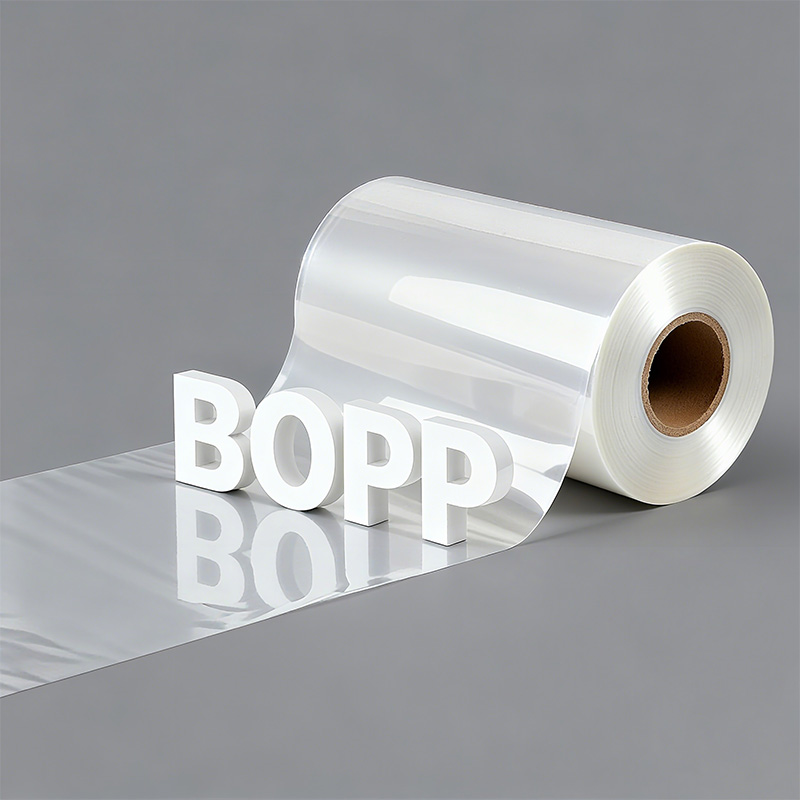
MoreThe main difference between PP and BOPP is that PP names the polymer, while BOPP names a film made from that polymer using biaxial orientation. BOPP is therefore part of the polypropylene family. Comparing "PP vs BOPP" without identifying the film-making process can create an unclear specification rather than a meaningful material comparison.
For a packaging buyer, the practical question is often whether a particular BOPP grade or another PP film, such as cast polypropylene, better suits the printing, sealing and handling requirements. This guide focuses on those differences and the information needed to compare quotations accurately.
Key Takeaways
PP is the family; BOPP is a film form within it. They are not two unrelated plastics.
Process matters. Cast film and biaxially oriented film can behave differently even though both use polypropylene.
Function comes from the grade. Sealability, printing compatibility and barrier performance are not determined by the abbreviation alone.
Compare equivalent jobs. Select the film against the finished pack and the converting conditions, rather than a universal better-or-worse ranking.
PP stands for polypropylene. The material can be processed into film and many other forms. A quotation that says only "PP film" does not fully describe the film's orientation, surface condition or application.
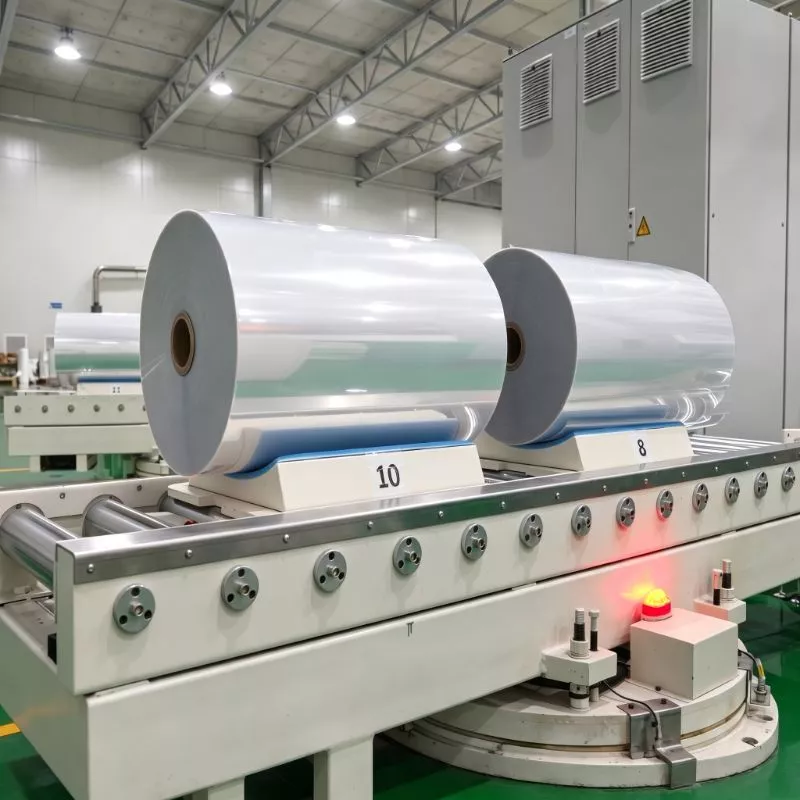
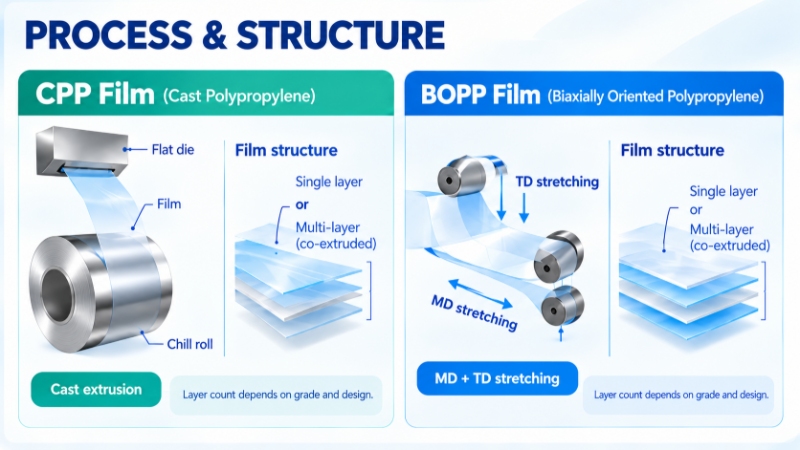
BOPP stands for Biaxially Oriented Polypropylene. It identifies a film that has been stretched in both the machine and transverse directions during manufacture. The resulting structure helps develop properties suited to printing, wrapping and other converting operations. For the broader material definition and manufacturing context, see what BOPP film is.
CPP means cast polypropylene film. It is made by a cast-film process rather than the deliberate biaxial stretching process that defines BOPP. CPP is one comparison point, but it should not be used as a synonym for every PP film that is not BOPP.
| Term on a quotation | What it identifies | What still needs clarification |
|---|---|---|
| PP | The polymer family | Film process, structure, grade and surface function |
| PP film | A film made from polypropylene | Whether it is cast, biaxially oriented or another specified form |
| BOPP film | Biaxially oriented polypropylene film | Thickness, layers, appearance, treatment, coating and end use |
| CPP film | Cast polypropylene film | Formulation, sealing behavior, appearance and application grade |
On smaller screens, swipe horizontally to view all columns.
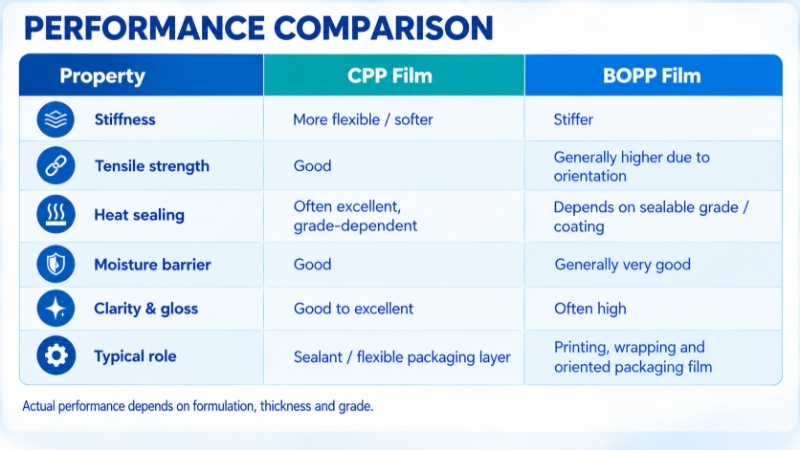
Biaxial orientation changes the internal arrangement of the polypropylene film. It is one reason many BOPP grades combine useful stiffness, tensile strength and optical performance at a relatively thin gauge. A cast film is designed through a different processing route, which can produce a different balance of flexibility and sealing behavior.
These are useful tendencies, not complete specifications. Formulation, layer structure, thickness and finishing all affect the film. Comparing a specialty coated BOPP with a general-purpose CPP and attributing every difference to orientation would overlook those other variables.
Stiffness describes how strongly a film resists bending. Tensile strength describes behavior under pulling force. Puncture, impact and tear tests measure other responses. A packaging structure may need several of these properties at once.
For example, a stiff film can support web handling or label dispensing without being the best choice for every sharp-cornered product. A more flexible film can conform to a shape yet require different tension settings. Compare the relevant tests and directions rather than using the word "strong" as a complete specification.
Both oriented and cast PP films can be designed for transparent applications. It is inaccurate to assume that everything called PP is cloudy and everything called BOPP is clear. Matte, white and pearlised BOPP intentionally have different optical characteristics.
Ask for haze, gloss or opacity information when it affects the product's appearance. Review the sample in the intended packaging or label construction, because ink, adhesives and other layers can change the visual result.
In flexible packaging, film layers can perform different jobs. One layer may carry the print and provide handling stiffness; another may provide sealing, toughness or product-contact functionality. The layers may complement each other rather than compete for the same role.
| Selection factor | BOPP direction to investigate | CPP or other PP direction to investigate |
|---|---|---|
| Printing and web handling | Appropriate stiffness, dimensional behavior and treated or coated print surface | Suitable print treatment and handling behavior for the proposed process |
| Flexibility and package feel | Check whether the selected BOPP gives the required stiffness or fold behavior | Evaluate cast-film grades when flexibility is central to the design |
| Heat sealing | Specify a BOPP grade with the required sealable surface or layer | Evaluate a suitable CPP sealant grade where the design calls for it |
| Product protection | Review the complete barrier structure, not just the BOPP base | Review whether the chosen grade provides the required protection or acts as a sealant layer |
| Tear, impact and puncture | Compare relevant test data for the actual thickness and structure | Compare the same tests and application conditions |
| Cost | Evaluate yield, coating and conversion performance | Evaluate equivalent finished-pack function and production efficiency |
On smaller screens, swipe horizontally to view all columns.
This comparison describes material-selection questions. It does not mean that every supplier offers every film type or that all grades within a type have the same performance.
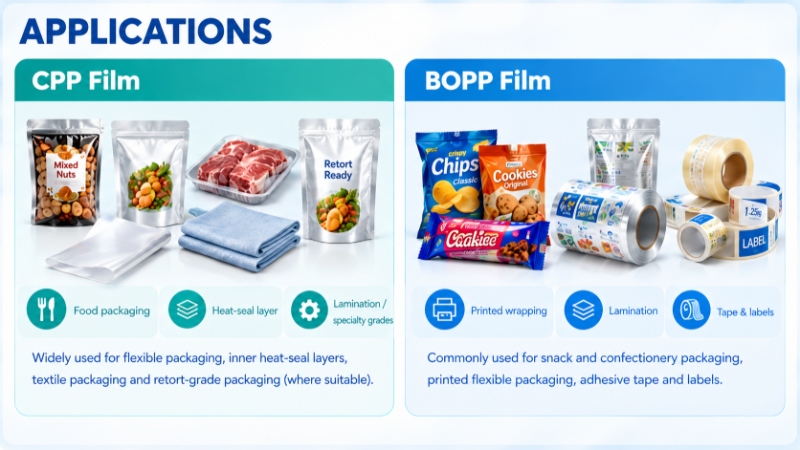
Specify which surface will be printed, the printing process and the ink system. A film suited to one flexographic ink may need a different treatment or coating for another digital or conventional process. A surface-energy reading alone does not describe every aspect of ink anchorage or durability.
For printed laminates, also identify whether the design uses surface or reverse printing and how the printed web will be bonded to the next layer. Ask the supplier and converter to qualify the intended combination before approving a production order.
Neither the word PP nor the word BOPP establishes the machine settings for a reliable seal. A BOPP product may be non-sealable, sealable on one side or sealable on both sides. A cast film must also be selected for the intended sealing operation and package requirements.
SAILLAGE's heat-sealable BOPP film series distinguishes one-side, two-side, low-temperature and matte options. The useful next step is to match the required function to the proposed grade, then establish sealing conditions through technical data and trials. Do not transfer one grade's temperature window to another film.
Identify the display appearance, sealing method, barrier needs and machine configuration. A printable outer web and a sealant layer may have different requirements. Evaluate the complete construction, including how it is laminated or wrapped, rather than assuming a change of polymer name solves the whole package.
For labels, ask about dispensing stiffness, print receptivity, die-cutting and the method used to apply the label. A pressure-sensitive label, a wrap-around label and an in-mold label do not use the same construction. "PP label" may identify the polymer family while leaving important application details unspecified.
BOPP-based synthetic paper and pearlised films are polypropylene products, even when they resemble paper. Opacity, density, surface treatment and the required printing process should be specified. A paper-like appearance does not establish equivalent absorption, recycling behavior or processing settings to cellulose paper.
Our guide to BOPP film types explains how appearance, coating, sealing function and end use interact when selecting a grade.
1.Define the film form. Replace an ambiguous "PP film" description with the required process and grade.
2.State the finished job. Include the package or label, product, distribution conditions and intended conversion route.
3.Identify the functional sides. Mark printing, coating, lamination, sealing or adhesive-contact surfaces clearly.
4.Compare like-for-like data. Match thickness, test method, temperature, humidity and MD/TD direction where relevant.
5.Review the full construction. Include coatings, other film layers, adhesive, printing and sealing requirements.
6.Qualify production performance. Agree on acceptance criteria and run representative material on the intended equipment.
Specific values for tensile strength, shrinkage, friction, barrier and sealing should come from the proposed grade's documentation. Supplier data from a different material or thickness should not be used to fill a gap in the quotation.
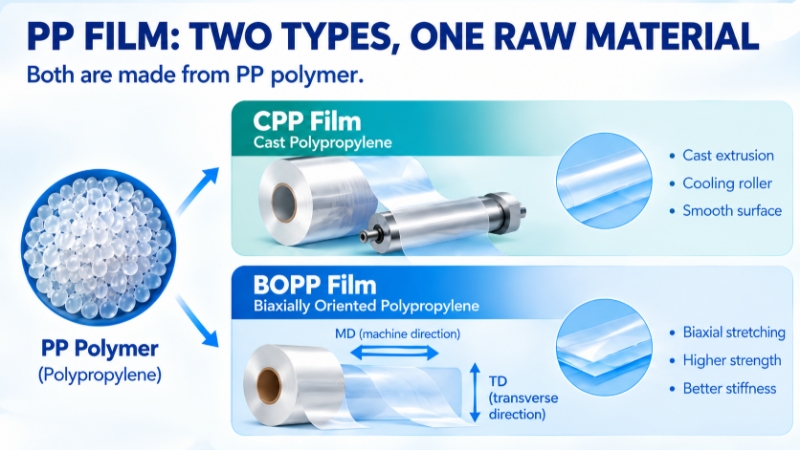
BOPP is made from polypropylene, so it belongs to the PP family. The additional letters identify biaxial orientation of the film, rather than a different base polymer.
No universal comparison follows from the term PP film alone. Many CPP grades are selected for flexibility, while many BOPP grades provide useful stiffness. The actual film structure, formulation and thickness must be compared.
It should not be assumed to be a direct replacement. Printing, winding, lamination, sealing and package performance may change. Select an appropriate grade and validate it under the intended production conditions.
The relevant comparison is between specified sealant grades, not PP as a polymer family and BOPP as a film form. Heat-sealable BOPP and suitable CPP grades can serve different designs; confirm the required seal surface and operating window.
PP vs BOPP is best understood as a question of material family, processing and film design. Once the film form is defined, the decision becomes more useful: which grade supplies the appearance, handling, printing, sealing and protection needed for the finished application?
For a sourcing discussion, provide the intended construction and converting conditions with your specification. That gives the supplier a clear basis for proposing a suitable BOPP grade and identifying where another film function is needed.



Select the most popular foreign trade service products to meet your diverse needs
Select the most popular foreign trade service products to meet your diverse needs

Tel: +86 17706217416
Add: Building L2A, No. 520, Lane 1588, Zhuguang Road, Hongqiao World Center, Qingpu District, Shanghai, China






User Comments
Service Experience Sharing from Real Customers
Marcus
Packaging EngineerAs someone who's been specifying films for five years, this breakdown saved me hours of explaining to our sales team. Finally, a clear comparison of PP's flexibility versus BOPP's stiffness and superior print surface. We use BOPP for our premium snack labels because the colors just pop differently. Bookmarked!
Chloe
Small Business OwnerHonestly, I was totally confused when my supplier asked which polypropylene I wanted for my candle sleeves. This article spelled it out in plain English. Went with BOPP for the glossy finish and it made my products look way more professional. One star off because I wish there was a bit more on cost comparisons for tiny batches like mine.
Raj
Procurement ManagerSpot on. We source films for medical device packaging, and the clarity on moisture barrier differences between PP and BOPP was critical. The oriented film (BOPP) has that consistent dimensional stability we need for automated filling lines. This is the kind of practical, no-fluff technical detail that's hard to find. Shared it with my whole team.
Kaitlyn
Graphic DesignerI'm not a materials expert—I just want my designs to look good! This finally explained why my vibrant labels sometimes looked dull on standard PP. BOPP's the way to go for high-gloss, scratch-resistant finishes. The bit about heat sealing temperature differences was a lifesaver before we sent our last order to the printer. Super helpful!