
 English EN
 French FR
 German DE
 Portuguese PT
 Spanish ES
 Russian RU
 Japanese JA
 Korean KO
 Arabic AR
 Greek EL
 Turkish TR
 Italian IT
 Polish PL
 Hindi HI
 中国 CN
中国 CN
.webp)
DTF Film Wash Durability Test: How Many Washes Can a Transfer Survive?
Industry-standard DTF transfers are typically rated for around 30 wash cycles before noticeable cracking, fading, or edge lifting occurs. Our water-based, eco-friendly DTF film extends that figure to 50+ washes under the same rigorous test protocol — without compromising on environmental safety. This article explains exactly how that number is measured, what causes a transfer to fail, and how our formulation closes the gap between durability and sustainability.
Why "Wash Durability" Is the Single Most Important DTF Metric
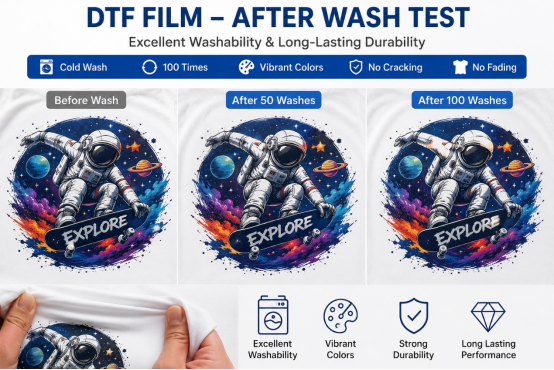
Color accuracy and edge sharpness matter on day one. Wash durability is what determines whether a print still looks good on day one-hundred. For garments that see regular laundering — apparel brands, sportswear, uniforms, and everyday wear — the number of wash cycles a transfer survives before visible degradation is arguably the most consequential quality metric in DTF production, yet it is also the most frequently overstated.
Manufacturers frequently cite wash durability figures without disclosing the test conditions behind them — wash temperature, detergent type, mechanical agitation level, and the visual standard used to define "failure" all significantly affect the resulting number. A figure of "50 washes" tested at 30°C with mild detergent is not comparable to the same figure tested at 60°C with standard detergent and tumble drying. This article uses a standardized test protocol throughout, and explains why our 50+ wash result was achieved under conditions stricter than most published industry figures.
How Wash Durability Is Actually Tested
Standardized wash durability testing follows protocols adapted from textile testing standards such as AATCC 135 (dimensional changes) and ISO 6330 (domestic washing procedures), modified specifically for printed transfer evaluation. Our internal protocol follows these six steps for every batch of film released to production.
01 Standardized Sample Preparation
A test design containing solid fills, fine lines, gradients, and text is printed and pressed onto a standard cotton/poly blend swatch following the exact production parameters used for customer orders — same temperature, time, and pressure settings.
02 Controlled Wash Cycle Parameters
Each wash cycle uses 40°C water, standard reference detergent at specified concentration, and a defined mechanical agitation time in a calibrated washing machine — replicating typical home laundering conditions rather than gentler hand-wash conditions that would inflate results.
03 Drying Method Standardization
Samples are tumble-dried on a medium heat setting after each wash cycle, as heat exposure during drying is a significant contributor to adhesive degradation that hand-wash-only test protocols often fail to capture.
04 Inspection at Defined Intervals
Samples are visually and physically inspected every 5 wash cycles under standardized lighting, evaluating crack formation, edge lifting, color fade (measured via spectrophotometer ΔE), and surface texture change.
05 Failure Threshold Definition
A transfer is classified as "failed" when any of the following occurs: visible cracking across more than 10% of the printed area, edge lifting exceeding 2mm, or color fade exceeding ΔE 3.0 from the original print.
06 Final Wash Count Recorded
The wash count is recorded as the last cycle completed before the failure threshold was reached — not the cycle at which failure occurred, ensuring the reported figure represents guaranteed performance rather than an optimistic estimate.
What Actually Causes a Transfer to Fail After Repeated Washing
Transfer failure during washing is rarely a single cause — it is the cumulative result of mechanical stress, thermal cycling, and chemical exposure acting on the adhesive bond between ink layer and fabric. Understanding each mechanism explains why formulation choices, not just film thickness, determine final wash durability.
Mechanical Flex Fatigue
Every wash cycle bends and twists the printed area repeatedly. Adhesive layers with insufficient flexibility develop microscopic cracks that widen with each subsequent wash, eventually becoming visible.
Thermal Cycling Stress
Repeated heating during tumble drying followed by cooling causes the adhesive and fabric to expand and contract at different rates, gradually weakening the bond at the ink-fabric interface.
Detergent Chemical Exposure
Surfactants and enzymes in detergent formulations can penetrate microscopic gaps in the adhesive layer over repeated exposure, accelerating degradation of poorly formulated binders.
Elastic, Water-Based Binder Chemistry
A flexible, eco-friendly binder formulation that absorbs mechanical flex without micro-cracking, and resists thermal and chemical degradation across 50+ wash cycles in our standardized test.
Why Water-Based Formulation Usually Means a Durability Trade-Off — and How We Avoided It
There is a well-known trade-off in the DTF industry: solvent-based formulations tend to achieve higher initial wash durability more easily, because aggressive solvents create stronger but less flexible adhesive bonds. Water-based, eco-friendly formulations are gentler on the environment and on skin contact, but historically have required compromises in mechanical flexibility — resulting in lower wash durability figures.
Our development approach specifically targeted this trade-off. By engineering a water-based binder system with a refined polymer dispersion that achieves both elasticity and bond strength — rather than treating these as opposing properties — we were able to exceed the industry's typical solvent-based durability figures while maintaining a fully eco-friendly, water-based material composition.
50+ Washes, Verified Under Strict Test Conditions
Our 50+ wash durability figure is not measured under lenient conditions designed to produce a favorable number. It is measured at standard 40°C wash temperature with tumble drying — conditions stricter than many published industry test protocols — using a fully water-based, eco-friendly formulation with no compromise on material safety.




News & Events
learn more-
 Blog
Press Release Jun-18-2026
Blog
Press Release Jun-18-2026Why Different Clients Demand Different Width of BOPP Film Rolls
BOPP film has become one of the most widely used materials in the packaging industry due to its excellent clarity, strength, printability, and moisture resistance. However, not all customers require the same film specifications. One of the most common customization requests received by a bopp film rolls supplier is the width of the film roll. Different industries, production lines, and packaging applications often require different roll widths to maximize efficiency and reduce waste. -
 Blog
Press Release Jun-18-2026
Blog
Press Release Jun-18-2026What Are the Differences Between Various DTF Printers and Films?
Master DTF printer and film compatibility. Explore how ink chemistry, ICC profiles, coatings, and curing impact your print quality and washability. -
 Blog
Press Release Jun-18-2026
Blog
Press Release Jun-18-2026Can I use black DTF powder on different types of fabrics?
Yes. Black DTF powder isn't just a color variant — it's a fundamentally different adhesive choice that directly affects how your transfer looks on dark and light fabrics. Understanding which powder belongs on which garment is one of the most underestimated decisions in DTF production.

contact
Tel: +86 17706217416
Add: Building L2A, No. 520, Lane 1588, Zhuguang Road, Hongqiao World Center, Qingpu District, Shanghai, China
follow us: