
 English EN
 French FR
 German DE
 Portuguese PT
 Spanish ES
 Russian RU
 Japanese JA
 Korean KO
 Arabic AR
 Greek EL
 Turkish TR
 Italian IT
 Polish PL
 Hindi HI
 中国 CN
.webp)
BOPP Label Material vs Vinyl vs Paper: Which Label Facestock Should Your Product Use?
Compare BOPP label material, vinyl, and paper fac...
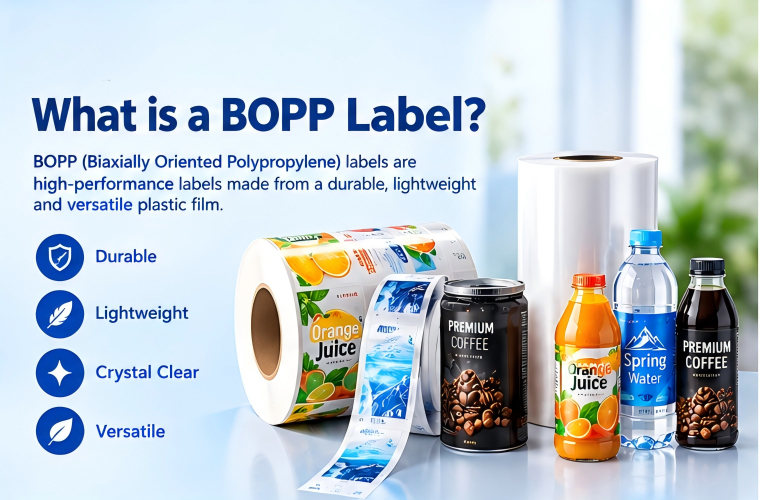
MoreA BOPP label uses biaxially oriented polypropylene film as its label face material. The film provides the surface that carries the printed design, but the complete label's performance also depends on its coating, ink, adhesive where used, and application method.
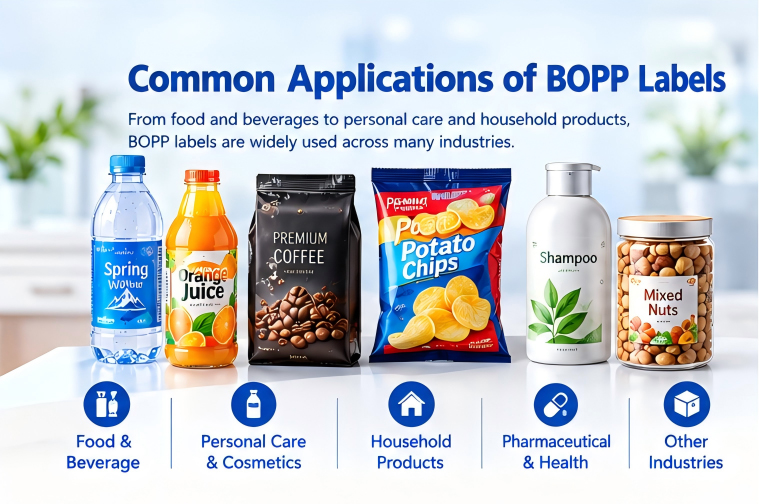
BOPP labels are used for beverage, personal care, household and other packaging where appearance and resistance to moisture are important. Clear film can create a no-label look, while white or pearlised film provides a background for graphics. Selecting the right construction is more important than treating all BOPP labels as one interchangeable product.
This guide focuses on label construction and use. For the underlying polymer, orientation process and general film properties, start with our explanation of what BOPP film is.
Key Takeaways
Facestock is the face material. It is not the same thing as a complete adhesive label.
Application methods differ. Pressure-sensitive, wrap-around and in-mold labels require different structures and conversion steps.
Moisture resistance is only one factor. Ink adhesion, edge lift, chemical exposure and label bonding need their own checks.
Printing must be qualified. Choose a treatment or coating suited to the actual ink and printing system.
In a pressure-sensitive label, the facestock carries the printed image. Below it, a pressure-sensitive adhesive bonds the label to the container. A release liner protects the adhesive and supports converting and dispensing before the label is applied. Printing and any protective varnish or laminate add further requirements to the construction.
These components have different jobs. The BOPP film can resist moisture, but that does not automatically make the printed image abrasion-resistant or the adhesive suitable for a wet, cold or oily surface. A reliable label requires the components to work together under the intended conditions.
| Component | Main role | What to check |
|---|---|---|
| BOPP facestock | Carries the design and gives the label its appearance and handling properties | Clarity or opacity, stiffness, dimensions and converting behavior |
| Print treatment or topcoat | Provides a surface suited to the intended printing process | Ink compatibility, anchorage and consistency |
| Printing and protective finish | Creates the design and, where specified, protects it | Cure or drying, rub resistance and product-exposure performance |
| Pressure-sensitive adhesive | Bonds the label to the container | Container material, application conditions, service conditions and removability needs |
| Release liner | Supports conversion and release during application | Die-cutting, release behavior, stiffness and dispensing equipment |
On smaller screens, swipe horizontally to view all columns.
This table describes a typical pressure-sensitive construction. Wrap-around and in-mold labeling follow different application routes, so they should not be specified by copying a pressure-sensitive adhesive-and-liner description.
Pressure-sensitive labels are supplied as a construction that can be released from its liner and applied using pressure. They are used where the label design, container geometry and application process suit this approach. Adhesive selection must account for the container surface, initial application conditions and subsequent use.
Permanent, removable and other adhesive functions belong to the label construction. They are not inherent characteristics of the BOPP facestock. A film supplier's range of label face materials should not be assumed to include every adhesive formulation or ready-to-apply finished label.
Wrap-around labels encircle a container and are applied using an appropriate gluing and labeling system. Film stiffness, dimensional behavior, surface finish and compatibility with that system are important. The design and machine setup differ from pressure-sensitive dispensing.
SAILLAGE's BOPP wrap-around label material is described for bottle-labeling applications with printing and hot-melt-glue compatibility. The selected film and glue must still be matched to the actual labeling line and container.
In-mold labels are placed into a mold and integrated with a container during a compatible molding process. The material must be qualified for the container resin, molding conditions, printing and handling method. This is a different construction from a self-adhesive label applied after the container has been formed.
| Label route | How the label is applied | Main specification focus |
|---|---|---|
| Pressure-sensitive | Released from a liner and bonded with a pressure-sensitive adhesive | Facestock, adhesive, liner and dispensing |
| Wrap-around | Wrapped around the container using the specified gluing system | Film handling, print surface, glue and labeling equipment |
| In-mold | Positioned in the mold and integrated during container production | Film, container resin, molding conditions and label handling |
On smaller screens, swipe horizontally to view all columns.
Clear BOPP is selected where product visibility and a no-label appearance are priorities. The container, adhesive, printed white ink and any finish all influence the final visual effect. A clear film alone does not guarantee an invisible label edge or an optically clear adhesive layer.
White BOPP provides a light background for printing. Pearlised BOPP can provide an opaque, paper-like appearance through an engineered film structure. Opacity, density and surface finish should be compared for the actual grade rather than inferred from the words white or pearlised.
Matte and glossy finishes describe surface appearance. Either needs to be specified alongside the printing and application requirements. A matte label is not automatically more scratch-resistant, and a glossy label is not automatically more durable.
BOPP has a non-absorbent polymer surface, so its treatment or coating must suit the ink and printing process. Surface treatment can support wetting and bonding; a print-receptive topcoat can provide a more specific interface for an intended printing system. Neither description means that the film works with every press and ink.
For flexo, identify the ink chemistry and drying or curing conditions. Check ink anchorage, rub resistance, web handling and the downstream converting steps. A film that performs well with one flexographic system should not be assumed to perform identically with another.
Inkjet compatibility should identify the relevant ink technology. A material designed for UV-curable ink may need a different surface from one intended for a water-based system. HP Indigo compatibility is also a specific printing requirement; general use of the word digital does not establish it.
For offset jobs, the film must suit the selected printing conditions and the handling format. Flatness, dimensional behavior, ink interaction and drying or curing affect the result. Subsequent die-cutting, slitting and label application should be included in qualification rather than treated as separate from print approval.
SAILLAGE distinguishes coated and non-top-coated face-material options. The non-top-coated BOPP label facestock is described as BOPP synthetic paper. That description establishes a product direction; it does not establish universal compatibility with every ink, adhesive or digital press.
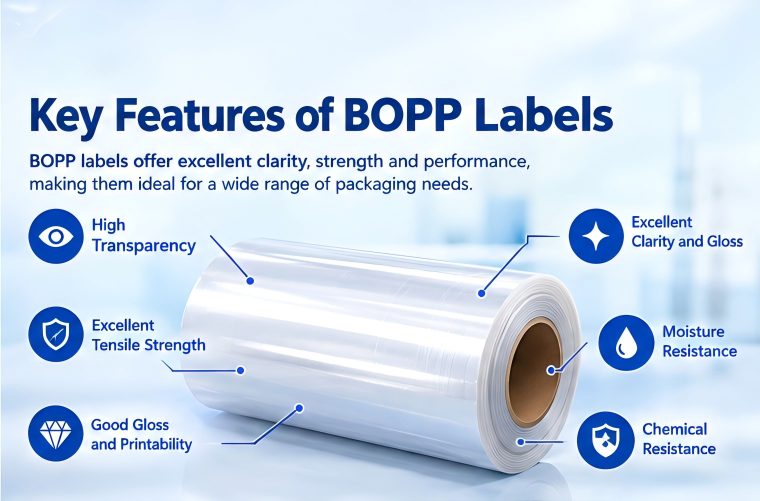
BOPP face material is often considered where moisture exposure or a film appearance makes paper less suitable. Paper may remain appropriate where its surface, printing behavior, cost or other characteristics fit the job. Comparing complete label constructions is more useful than declaring one material superior in all conditions.
For a refrigerated bottle, evaluate condensation, application temperature and bond development. For cosmetics or household goods, test contact with the actual product and handling conditions. For a squeezable container, assess conformability and label recovery on that container. For outdoor use, require evidence for the complete printed label under the intended exposure.
"Waterproof" should not be used as a shortcut for all these requirements. The film, image and adhesive can fail in different ways, and a successful water-resistance check does not establish chemical, ultraviolet or high-temperature durability.
1.Identify the application route: pressure-sensitive, wrap-around or in-mold.
2.Describe the container: material, shape, surface finish and any squeezing or flexing.
3.State application conditions: surface cleanliness, temperature and the equipment used.
4.Define service conditions: refrigeration, condensation, product contact, abrasion or outdoor exposure.
5.Specify the printing system: press, ink chemistry, drying or curing and required finish.
6.Choose the face appearance: clear, white, pearlised, glossy or matte, with measurable requirements where needed.
7.Qualify the construction: review the relevant technical documentation and test representative labels on actual containers.
Common trial observations include ink transfer, scuffing, edge lift, bubbles, wrinkles, liner-release problems and inconsistent dispensing. Record the conditions as well as the result. An isolated defect can come from material, ink, adhesive, application or machine settings; it should not automatically be attributed to the BOPP base film.
The recyclability of a labeled package depends on more than the BOPP face material. The container, adhesive, ink, coverage and the relevant recycling stream all matter. A washable or recycling-compatible adhesive is a specific system choice, not a property shared by every BOPP label.
Likewise, suitability for food, pharmaceutical or other regulated uses requires documentation for the intended application. A general label description does not establish approval for direct food contact, every container material or every service condition.
BOPP label film is the face material used to carry the design. A finished label also incorporates the required printing and, depending on its application route, an adhesive, liner or other functional elements.
BOPP facestock is moisture-resistant, but the performance of the finished label also depends on its ink, protective finish, adhesive and application conditions. Specify and test the complete label for the intended exposure.
No. The treatment or coating must match the relevant printing technology and ink. Confirm the specified press compatibility and run print and conversion trials before production approval.
No. Wrap-around labels use a specified wrapping and gluing process. Pressure-sensitive labels use an adhesive construction commonly carried on a release liner. Their film handling and application requirements differ.
A useful BOPP label specification connects the face material with the printing process, label construction and container. The film can contribute appearance, stiffness and moisture resistance, while the other components determine how the complete label prints, converts and performs in use.
For a material enquiry, provide the label route, container, printing process and exposure conditions. This gives SAILLAGE a practical basis for discussing a suitable face-material option without assuming that every BOPP grade serves the same labeling job.
Select the most popular foreign trade service products to meet your diverse needs
Select the most popular foreign trade service products to meet your diverse needs

Tel: +86 17706217416
Add: Building L2A, No. 520, Lane 1588, Zhuguang Road, Hongqiao World Center, Qingpu District, Shanghai, China








User Comments
Service Experience Sharing from Real Customers
Sarah
Warehouse ManagerHonestly, I was a bit skeptical about switching from paper labels to BOPP, but these things are tough. We store a lot of cleaning chemicals, and regular labels would always peel or smudge. These BOPP labels have been on for three months now, and they still look brand new. No curling, no fading. A solid win for our inventory system.
Mike
Brewery OwnerWe use BOPP labels for all our craft beer bottles, and they handle the ice bath like a champ. The only reason I’m giving 4 stars instead of 5 is that they can be a pain to remove if you mess up the application. But for durability and print quality? Absolutely top-notch. Customers love the glossy finish too.
Liam
Product Packaging SpecialistI've been in packaging for over a decade, and BOPP labels are my go-to for any product that faces moisture or abrasion. We just switched over for our line of organic skincare serums, and the clarity of the print on the white BOPP is stunning. No yellowing under UV light either. Highly recommend for anyone needing a premium look that lasts.
Jack
Small Business OwnerI run a small hot sauce operation out of my garage, and these BOPP labels saved me from a ton of returns. My old paper labels would get greasy and fall off. Now, even after sitting in the fridge for weeks, the labels stay put and still look vibrant. Totally worth the extra few cents per label.