
 English EN
 French FR
 German DE
 Portuguese PT
 Spanish ES
 Russian RU
 Japanese JA
 Korean KO
 Arabic AR
 Greek EL
 Turkish TR
 Italian IT
 Polish PL
 Hindi HI
 中国 CN
.webp)
PETG Shrink Film Yield: Comparing m²/kg and Usable Sleeve Output
PETG Shrink Film Yield: Comparing m²/kg and Usable Sleeve Output
Shrink sleeve converters operate under a fundamental commercial mismatch: raw film is purchased by weight (kilograms), but finished sleeves are sold by unit count (per thousand pieces). When procurement teams evaluate a PETG shrink film factory solely on per-kilogram pricing, they frequently overlook the hidden variables that erode petg shrink film yield on the press and seaming floor.
A roll priced 6% lower per kilogram can easily generate a higher total petg converting cost if it arrives with positive gauge drift, inconsistent transverse tension, or excessive factory splices. Accurate cost modeling requires tracking the film from gross invoice weight down to net, shippable sleeves.
Quick Answer
True PETG shrink film yield is determined by net usable sleeve output, not theoretical square metres per kilogram. While a standard 50-micron PETG film (density 1.32 g/cm³) has a nominal yield of 15.15 m²/kg, positive thickness tolerance (+5%), edge trim (4%), splices, and seaming scrap can reduce usable output by up to 15%. Specifying tight-tolerance film (±2%) lowers total converting cost per 1,000 sleeves even at a higher per-kilogram purchase price.
Key Takeaways
Weight vs. Area: Purchasing by weight transfers the financial risk of positive thickness tolerance directly to the converter.
Nominal Baseline: At 1.32 g/cm³ density, 40 µm PETG yields 18.94 m²/kg, 45 µm yields 16.84 m²/kg, and 50 µm yields 15.15 m²/kg.
Gauge Drift Penalty: Every +1 µm of excess thickness on a 50 µm film silently removes 1.96% of the linear metres from the roll.
Converting Losses: Edge trim, splice stops, seaming overlap, and shrink-tunnel rejects must be modeled together to calculate true cost per 1,000 sleeves.
Differentiating Kilograms, Nominal Area, and Usable Area
Accurate yield auditing requires separating three distinct metrics: gross purchased weight, nominal surface area, and net usable area. Confusing these tiers leads to distorted job costing and unexplained material variances during month-end inventory reconciliations.
Material Properties: Density and Thickness Governance
PETG (polyethylene terephthalate glycol) used in shrink sleeves is an amorphous copolyester with a standard density (ρ) of 1.31 to 1.33 g/cm³ (measured per ISO 1183 or ASTM D1505). Unlike crystalline polymers, PETG density remains highly stable across production batches. Consequently, thickness (t) is the primary variable governing linear yield.
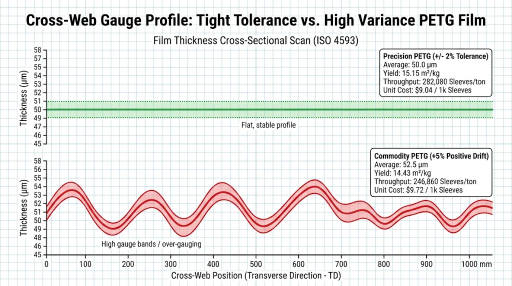
Film thickness is verified via mechanical scanning under ISO 4593. While a datasheet may specify "50 µm," extrusion tolerances vary widely between suppliers. A commodity supplier may operate at ±5% to ±7% tolerance, whereas a precision extruder holds ±2% to ±3%.
Structural Definitions of Yield Tiers
Gross Weight (kg): The invoiced weight of the master or slit roll, excluding the core and packaging. This metric has no direct correlation to sleeve count until density and actual thickness are verified.
Nominal Area (m²/kg): The theoretical surface area calculated from the target datasheet thickness and density. This is a mathematical baseline, not a production reality.
Net Usable Area (m²): The remaining film area after deducting actual gauge variance, printing and slitting edge trim, splice waste, seaming overlap, and quality-control rejects.
Operational Mechanism: The Silent Drain of Positive Gauge Drift
When a film supplier runs extrusion lines on the heavy side of tolerance (e.g., averaging 52.5 µm on a nominal 50 µm order) to avoid web breaks, the converter receives fewer linear metres per kilogram. Because the roll still weighs the invoiced 1,000 kg, incoming receiving docks rarely flag the discrepancy unless QC physically measures the roll length or scans the cross-web gauge profile.
Calculating Yield Using Density, Thickness, Edge Trim, and Splices
Evaluating petg shrink film square metres per kilogram begins with the standard gravimetric yield formula, followed by systematic deductions for mechanical converting losses.
The Core Gravimetric Formula
To establish the nominal area per kilogram (Y_nom), apply the following equation:
Ynom (m²/kg) = 1,000 ÷ [density (g/cm³) × thickness (µm)]
Using the industry-standard PETG density of 1.32 g/cm³, the nominal yields for common sleeve gauges are:
40 µm PETG: 1,000 / (1.32 x 40) = 18.94 m²/kg
45 µm PETG: 1,000 / (1.32 x 45) = 16.84 m²/kg
50 µm PETG: 1,000 / (1.32 x 50) = 15.15 m²/kg
If a 50 µm roll actually averages 52.5 µm (+5% positive tolerance), the real yield drops immediately:
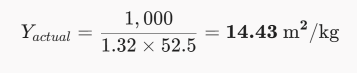
That single +2.5 µm variance eliminates 0.72 m² from every kilogram—a 4.76% loss before the roll is even mounted on the printing press.
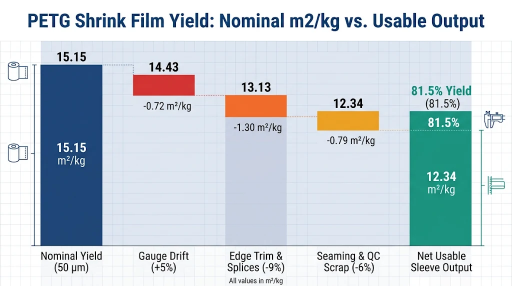
Deducting Edge Trim and Factory Splices
Once the roll enters rotogravure or flexographic printing and subsequent slitting, two unavoidable mechanical losses reduce the available web:
Edge Trim Loss: Presses require unprinted margins for registration marks, color bars, and slitter blade clearance. Standard trim ranges from 10 mm to 15 mm per side (20–30 mm total). On a 600 mm printed web, a 25 mm total trim removes 4.17% of the film area.
Splice and Setup Waste: Every factory splice inside a raw roll forces the press operator to slow down or stop to protect gravure cylinders and doctor blades, typically wasting 50 to 100 linear metres per splice event. Rolls with poor winding tension or gauge bands also extend color-registration setup times, pushing setup and splice waste from a benchmark 2% up to 5%–8%.
Factoring Seaming and Shrinkage Losses for Usable Sleeve Output
Converting printed, slit rolls into finished tubing introduces solvent-seaming mechanics and downstream thermal qualification. These stages determine the final usable sleeve output.
Seaming Overlap and Solvent Bonding Scrap
During center-sealing (seaming), the two edges of the film overlap to create a structural bond using tetrahydrofuran (THF) or 1,3-dioxolane-based solvents.
Overlap Consumption: A standard overlap is 4 mm to 6 mm. For a container requiring a 120 mm layflat sleeve (240 mm circumference), a 5 mm overlap consumes 2.04% of the net slit width.
Seaming Rejects: Gauge bands (localized thick spots across the web) cause uneven layflat tension on the forming plow. This results in "smiling" seams, solvent blistering, or weak peel strength. High-precision film typically holds seaming and inspection scrap to 1.5%–2.0%, whereas high-variance film can trigger 5%–7% scrap rates.
Downstream Shrink Tunnel Qualification
Even if a sleeve passes seaming inspection, inconsistent transverse direction (TD) shrinkage or excessive machine direction (MD) shrinkage (tested per ASTM D2732) causes bottling-line rejects such as dog-ears, bridging, or graphic distortion. Converters absorbing customer chargebacks for tunnel rejects must factor this into their true petg converting cost.
Cost-Per-1,000-Sleeves Comparison: Commodity vs. Precision PETG
The table below models a 1,000 kg order of 50 µm PETG converted into sleeves requiring 0.05 m² per sleeve (250 mm slit width × 200 mm cut length).
| Performance & Cost Metric | Commodity PETG Roll (High Variance) | Precision-Controlled PETG Roll (Tight Tolerance) |
|---|---|---|
| Purchase Price per kg | $2.40 / kg | $2.55 / kg (+6.25%) |
| Total Raw Material Spend (1,000 kg) | $2,400.00 | $2,550.00 |
| Actual Average Thickness | 52.5 µm (+5% drift) | 50.0 µm (±2% tolerance) |
| Actual Film Area (m²/kg) | 14.43 m²/kg | 15.15 m²/kg |
| Total Incoming Film Area | 14,430 m² | 15,150 m² |
| Edge Trim, Setup & Splice Loss | 9.0% (1,299 m² lost) | 5.0% (758 m² lost) |
| Seaming & QC Scrap Rate | 6.0% (788 m² lost) | 2.0% (288 m² lost) |
| Net Usable Film Area | 12,343 m² | 14,104 m² |
| Usable Sleeve Output (at 0.05 m²/sleeve) | 246,860 sleeves | 282,080 sleeves (+14.3%) |
| Raw Material Cost per 1,000 Sleeves | $9.72 | $9.04 (-7.0%) |
| Press & Seamer Efficiency | Frequent stops; high registration waste | Continuous high-speed run; stable tension |
Despite carrying a 6.25% higher per-kilogram price, high-precision PETG shrink film produces 35,220 more usable sleeves per metric ton and reduces raw material cost per 1,000 sleeves by 7.0%—before accounting for reduced press downtime and lower ink/solvent waste.
Actionable Procurement & QC Checklist
To protect converting margins, engineering and purchasing teams should implement the following verification protocol:
✅ Audit Incoming Linear Length: Cross-check the supplier's stated roll length against the roll weight using the gravimetric formula. Any discrepancy exceeding 2% indicates positive gauge drift.
✅ Mandate Cross-Web Gauge Profiles: Require a beta-gauge or mechanical thickness profile certificate (ISO 4593) with every master roll shipment, specifying a maximum tolerance of ±2% to ±3%.
✅ Cap Factory Splices: Stipulate in purchase orders a maximum of 1 flagged splice per 3,000 linear metres, with zero splices allowed within the first or last 300 metres of the roll.
✅ Verify Shrinkage Uniformity: Test incoming lots per ASTM D2732 at 70°C, 80°C, and 95°C to confirm TD shrinkage consistency and ensure MD shrinkage remains below 3%.
✅ Standardize Costing Models: Shift internal ERP quoting from "cost per kg" to "net cost per 1,000 usable sleeves" using historical scrap rates by supplier.
Frequently Asked Questions
How do you calculate PETG shrink film square metres per kilogram?
Divide 1,000 by the product of the film's density (in g/cm³) and its thickness (in microns). For standard 50-micron PETG with a density of 1.32 g/cm³, the nominal yield is 15.15 m²/kg.
Why does usable sleeve output fall short of nominal film yield?
Nominal yield assumes zero thickness variance and zero processing waste. In production, positive gauge drift, printing edge trim, factory splices, seaming overlap, and shrink-tunnel rejects typically reduce usable sleeve output by 7% to 15%.
How does positive thickness tolerance increase PETG converting cost?
Because raw film is purchased by weight, a +5% positive thickness tolerance reduces the linear metres on every roll by 4.76%. Converters pay the same per-kilogram price but produce significantly fewer finished sleeves per roll.
What thickness tolerance should procurement specify for high-speed sleeve converting?
Procurement and QC teams should specify a maximum thickness tolerance of ±2% to ±3% across the web, verified via ISO 4593 mechanical scanning, alongside a maximum limit of one splice per 3,000 linear metres.
Optimizing Your Converting Margins
Eliminating hidden yield loss requires aligning raw material procurement with pressroom engineering metrics. By auditing actual linear metres per kilogram, enforcing strict cross-web thickness tolerances, and tracking net usable sleeve output, converters can systematically lower their per-unit production costs while improving seaming and shrink-tunnel reliability.
Review our complete PETG shrink film specifications to compare gauge tolerances, shrinkage curves, and custom slitting capabilities, or contact our technical engineering team to request a trial roll and run a side-by-side yield audit on your converting line.




News & Events
learn more-
 Blog
Press Release Nov-25-2026
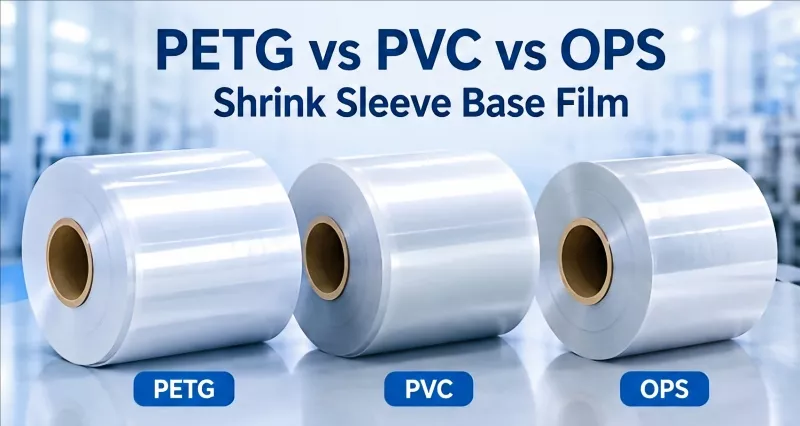
PETG vs PVC vs OPS Shrink Sleeve Film | Saillage
Compare PETG, PVC and OPS shrink sleeve base films by shrink profile, container fit, printing, converting, cost and application requirements. -
 Blog
Press Release Nov-25-2026
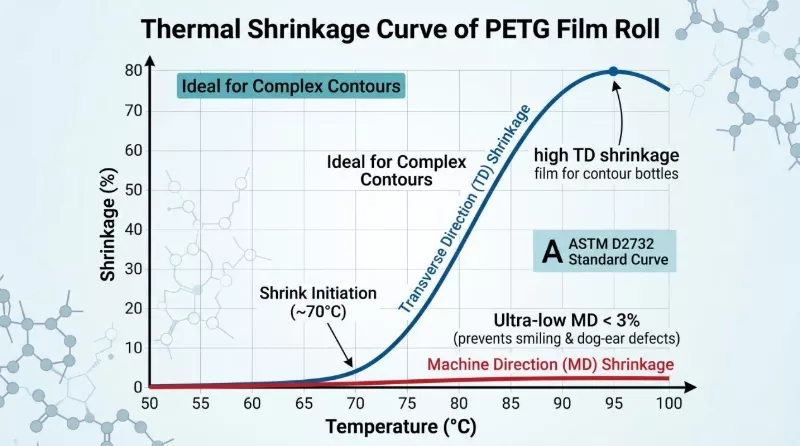
PETG Film Roll: Prevent Dog-Ears on Contour Bottles h1: High-Shrink PETG vs. Complex Bottle Contours: Defect Prevention
Master high TD shrinkage film for contour bottles to eliminate dog-ears and smiling effects. Increase yield by 15% with optimized PETG film roll selection. -
 Blog
Press Release Nov-25-2026
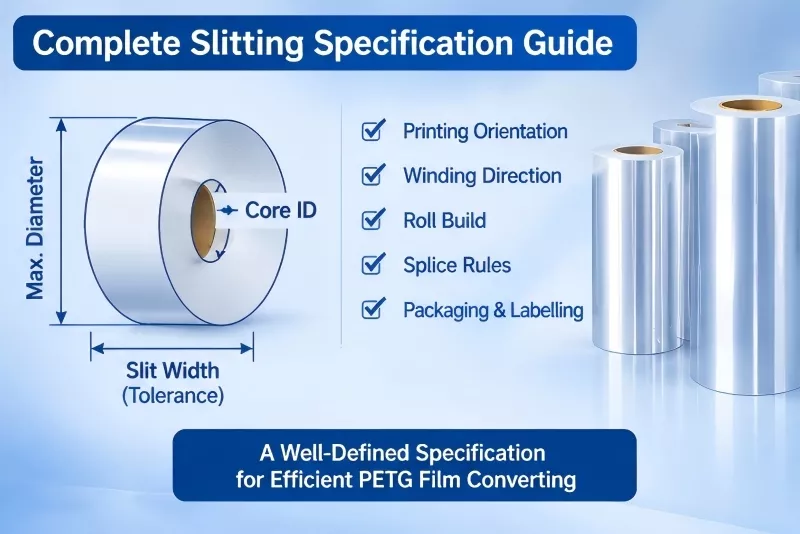
Slitting PETG Shrink Film Master Rolls: Winding Direction, Roll Build and Splice Specs
Learn how to specify PETG shrink film slitting, including winding direction, roll build, splice control, slit-roll dimensions, traceability and line qualification.

contact
Tel: +86 17706217416
Add: Building L2A, No. 520, Lane 1588, Zhuguang Road, Hongqiao World Center, Qingpu District, Shanghai, China
follow us: