
 English EN
 French FR
 German DE
 Portuguese PT
 Spanish ES
 Russian RU
 Japanese JA
 Korean KO
 Arabic AR
 Greek EL
 Turkish TR
 Italian IT
 Polish PL
 Hindi HI
 中国 CN
.webp)
PETG vs PVC vs OPS Shrink Sleeve Film | Saillage
A technical selection guide for shrink sleeve converters, film distributors and packaging buyers
Introduction
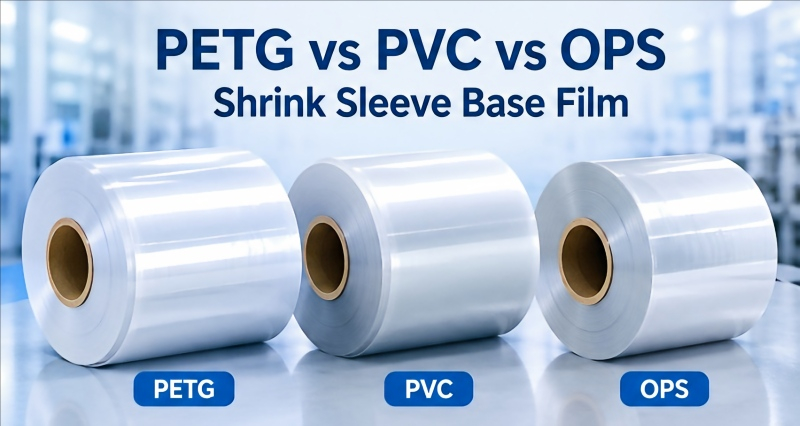
Selecting shrink sleeve film is not simply a question of choosing the material with the lowest price per kilogram. For a converter, the base film determines the usable shrink profile, print performance, converting stability, packaging-line compatibility and the risk of rejects at the customer’s filling plant. The choice among PETG shrink sleeve base film, PVC and OPS is particularly important when a sleeve must fit a container with pronounced shoulders, recessed panels, changing diameters or a complex silhouette.
The search terms petg vs pvc shrink film and petg shrink film vs OPS often suggest that one material is universally better. That is not how a technically sound specification should be made. Each polymer has a different balance of shrink force, shrink range, stiffness, density, processing window, environmental profile and cost. A suitable selection starts with the container geometry and the actual sleeve application, then checks the film against printing, seaming, cutting, shrinking and logistics requirements.
Key Takeaways
PETG is commonly selected where high shrink capability and demanding contour conformity are priorities
PVC remains a cost-conscious option for applications whose shrink demand and market requirements suit it
OPS can be attractive where lower shrink force and particular processing or sustainability objectives are important.
Actual performance depends on grade, gauge, orientation, shrink curve and process conditions. Converters should qualify the film on their own equipment rather than select by polymer name alone.
Technical Core: How the Three Materials Behave
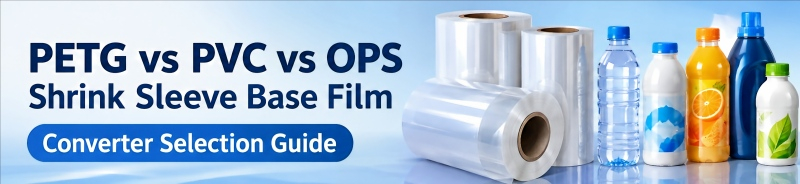
Shrink sleeve films are typically oriented polymer films. Orientation is the controlled stretching of a polymer web during manufacture, which aligns molecular chains. When heat is applied during sleeve shrinking, the oriented structure relaxes toward a lower-energy state and the film contracts. The amount of contraction in the machine direction (MD) and transverse direction (TD) is not necessarily equal. For sleeve applications, TD shrink is often central to fitting the container circumference, while MD behaviour influences sleeve height and registration control.
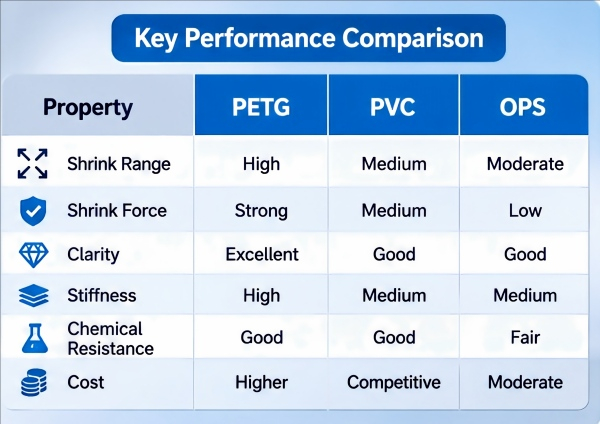
PETG (glycol-modified polyethylene terephthalate) is a copolyester. Its molecular modification changes crystallisation behaviour and makes it suitable for producing clear, oriented shrink film with a high potential shrink range. High Shrink transparent PET-G Film is often considered for containers with complex profiles, but high free shrink alone is not enough: shrink force, shrink onset, maximum shrink temperature, residual shrink, gauge and dimensional stability must also match the container and tunnel. A film with excessive shrink force can distort lightweight containers, pull at seams or create wrinkles around transitions.
PVC (polyvinyl chloride) shrink film has long been used in sleeve labels because it can provide useful shrink performance and established converting characteristics at a competitive material cost. Its behaviour depends on formulation, plasticiser system where applicable, orientation and film gauge. Converters should also consider regional regulatory, customer and end-of-life requirements for PVC-containing packaging. These requirements vary by market and application, so they should be checked against the destination market rather than assumed.
OPS (oriented polystyrene) is a biaxially oriented polystyrene shrink film. It is often associated with relatively low shrink force and good suitability for containers that are more sensitive to deformation. Its stiffness and shrink response differ from PETG and PVC, and the available shrink profile may constrain its use on highly contoured packages. Handling, storage and line conditions matter because oriented films can respond differently to temperature and mechanical stress.
A meaningful comparison of shrink sleeve film materials therefore needs more than a single headline shrink percentage. Review the free-shrink curve at several temperatures, shrink force, natural shrink during storage, tensile and tear behaviour, optical properties, coefficient of friction, surface treatment, ink adhesion and solvent resistance where relevant. Confirm which side is treated and whether the film is designed for the intended print process. The phrase transparent heat shrink PETG sleeve label film describes a product category, not a complete technical specification.
Application & Solutions: Match the Film to the Container and Process
1. Complex shapes and high contour coverage.
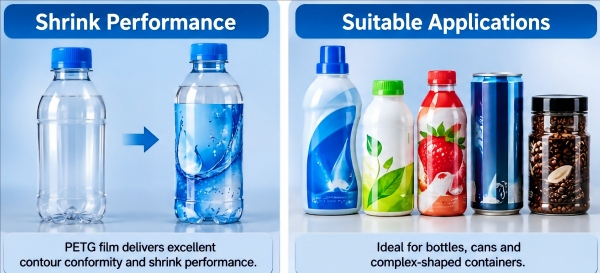
PETG is frequently evaluated for bottles with deep waist sections, pronounced shoulders, narrow necks or multiple diameter changes. Its high shrink potential can help the sleeve follow these contours, provided the shrink curve is matched to the container and tunnel. A converter should map the container circumference at several heights, calculate the required local shrink, and compare those values with the supplier’s TD free-shrink data. Do not use the maximum shrink figure as the only selection criterion: the film must shrink progressively without causing panel distortion, bridging or excessive seam stress.
2. Lightweight or deformation-sensitive containers.
OPS may be worth testing when the container wall is thin or the package is susceptible to deformation under heat and shrink force. Run trials at the lowest effective tunnel temperature and exposure time, then inspect for ovality, panel collapse and dimensional change. PETG or PVC may still be suitable, but their shrink force and heat profile must be assessed against the container’s thermal tolerance. The container supplier’s limits should take precedence over generic tunnel settings.
3. Cost-sensitive, established applications.
PVC can remain commercially practical where its performance is sufficient, the customer accepts the material and local requirements permit its use. A fair cost comparison should include more than purchase price per kilogram. Compare film density and gauge, usable roll length, print and seaming yield, line speed, scrap, freight, storage, compliance costs and any customer-specific material restrictions. A lower-priced film can become more expensive if it produces more rejects or requires slower processing.
4. Printing, seaming and sleeve conversion.
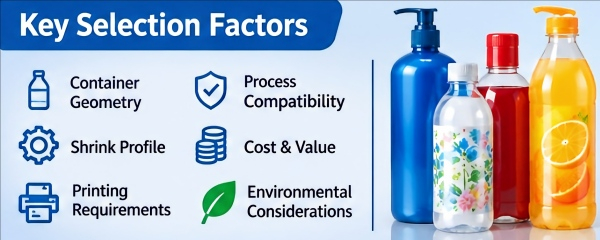
The selected film must work with the converter’s printing technology, ink system, drying capacity, solvent management, seaming adhesive or solvent, and cutting equipment. Surface energy and treatment level can affect wetting and ink anchorage, but a dyne value by itself does not guarantee print adhesion. Test the actual ink, coating, curing conditions and print coverage. For seamed sleeves, evaluate seam strength, seam appearance, solvent attack, shrink behaviour at the seam and the effect of heavy ink coverage.
5. Shrink tunnel and filling-line integration.
Steam and hot-air systems transfer heat differently. A film that performs well in one tunnel may not deliver the same result in another because of differences in temperature distribution, airflow, steam pressure, conveyor speed, bottle spacing and exposure time. Establish a process window rather than relying on a single machine setting. Record the tunnel profile, line speed, container temperature, sleeve position and defect rate. Inspect for wrinkles, dog-ears, bridging, pinholes, trapped air, label movement, seam opening and container deformation.
6. Warehousing and distribution.
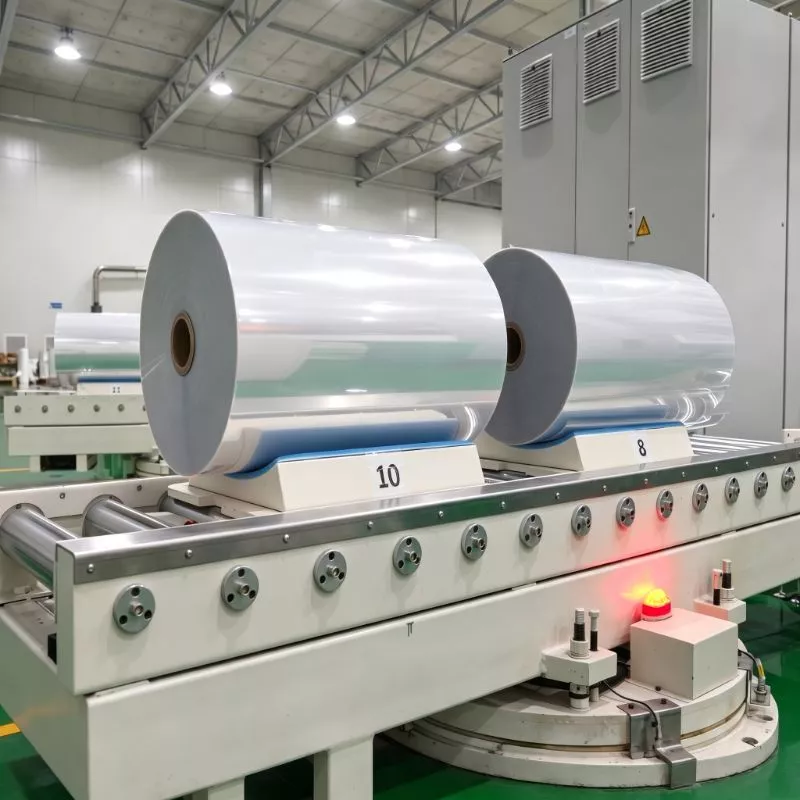
Roll storage conditions influence dimensional stability and converting consistency. Protect rolls from direct sunlight, excessive heat, moisture, dust and physical damage. Keep rolls in original packaging until conditioning and production, and avoid placing heavy loads on roll edges. Define storage temperature and humidity limits with the film supplier because allowable conditions vary by grade. Before production, check for telescoping, blocking, edge damage and changes in roll hardness.
The table below is a decision framework, not a claim that every grade of a polymer has identical performance. Supplier data and production trials should confirm the specific grade.
FAQ: Technical and Purchasing Questions
Is PETG always better than PVC for shrink sleeves?
No. PETG can be advantageous when high shrink and complex contour coverage are required, but it may not be the most economical or process-efficient choice for every container. PVC can remain suitable where its shrink profile, customer acceptance and market requirements align. Compare actual grades under the same conversion and shrinking conditions.
What’s the difference between PETG shrink film and OPS film?
The main practical differences are polymer chemistry, shrink profile, shrink force, stiffness and processing response. PETG is often considered for higher-shrink applications and complex shapes. OPS is often assessed where a lower shrink-force profile is useful. Exact behaviour varies by grade, gauge and orientation, so request technical data and conduct a container-specific trial.
How should a converter compare the performance of PETG films VS PVC film?
Compare TD and MD free shrink at several temperatures, shrink force, dimensional stability, tensile and tear properties, optical quality, surface treatment, print adhesion, seam performance and tunnel results. Use consistent test conditions and record the test method. A single shrink percentage or dyne reading is not enough to predict line performance.
Which technical documents should be requested before placing an order?
Request a current TDS, relevant test methods, roll and packaging specifications, recommended storage conditions, product identification and traceability details, and a sample for print, seam and shrink trials. Where the application or destination market has specific regulatory requirements, request applicable declarations and supporting documentation. Confirm that the supplied grade and production lot match the approved specification.
Conclusion & Action Guide
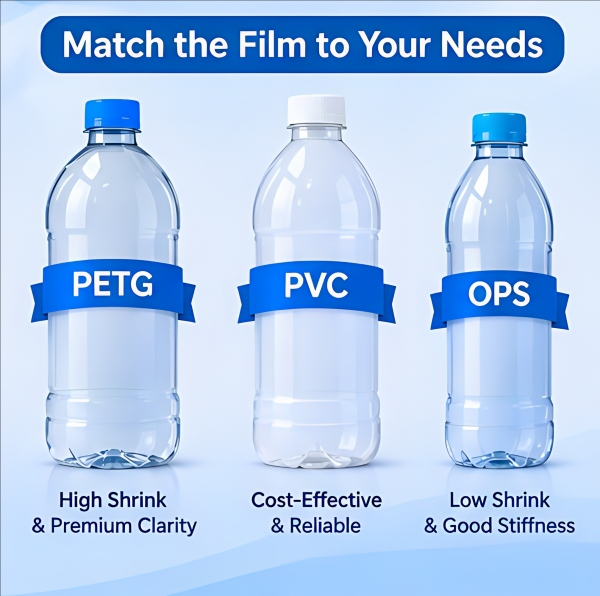
The correct shrink sleeve base film is the one that meets the container’s geometry, survives the converting process and runs reliably on the customer’s shrinking line at an acceptable total cost. PETG, PVC and OPS each have a place in the market; the decision should be based on measured shrink behaviour, shrink force, print and seam performance, line compatibility and destination-market requirements. For a new project, share the container drawing or sample, target sleeve dimensions, printing method, tunnel type and expected line speed with your film supplier. Request the relevant TDS and trial rolls, then approve the material against a documented test plan before full-scale purchasing.
Material Comparison at a Glance
| Selection factor | PVC | PETG | OPS |
|---|---|---|---|
| Shrink potential | Grade-dependent; often adequate for standard contours | Often offers a high shrink range for complex contours | Commonly selected for lower-force applications; grade-dependent |
| Shrink force | Must be checked against container strength | Can be significant at high shrink; validate lightweight packs | Often lower than high-shrink alternatives; confirm by grade |
| Complex geometry | Suitable when shrink curve covers required profile | Frequently evaluated for deep contours and demanding coverage | May be limited where very high local shrink is required |
| Converting | Established converting experience in many markets | Requires matched printing, seaming and tunnel conditions | Pay attention to stiffness, handling and line setup |
| Cost | Often competitive; assess total conversion cost | May carry higher material cost; assess yield and performance value | Market- and grade-dependent; compare delivered cost |
| Compliance / end of life | Check market restrictions and customer policies | Check local collection and recycling compatibility | Check local collection and recycling compatibility |
Converter Selection Checklist
☑ Measure the container at multiple heights and identify the maximum local shrink requirement, including tolerances and container variation.
☑ Obtain MD and TD free-shrink curves at multiple temperatures, plus shrink-force data where available. Confirm test method and specimen conditions.
☑ Check nominal thickness, thickness tolerance, width, roll length, winding direction, splice policy, core size and roll-weight limits against press and slitter specifications.
☑ Confirm treatment side, surface-energy target, print compatibility, ink adhesion, drying requirements and resistance to intended inks or solvents.
☑ For seamed sleeves, qualify seam strength before and after shrinking and inspect seam appearance on the actual container.
☑ Run a controlled tunnel trial. Document temperature, exposure time, conveyor speed, steam or airflow conditions and defects.
☑ Evaluate total cost per accepted sleeve, not only price per kilogram. Include material usage, waste, downtime, freight, storage and customer quality costs.
☑ Approve a written specification and retain a reference sample. Set incoming inspection criteria for each delivery and define deviation handling.




News & Events
learn more-
 Blog
Press Release Nov-21-2026
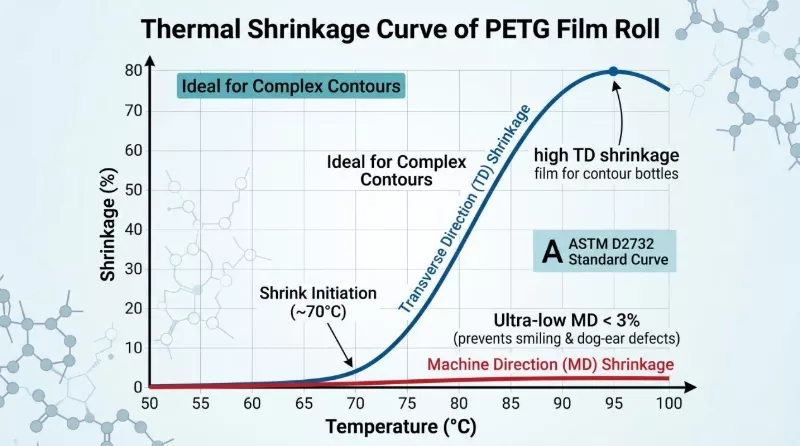
PETG Film Roll: Prevent Dog-Ears on Contour Bottles h1: High-Shrink PETG vs. Complex Bottle Contours: Defect Prevention
Master high TD shrinkage film for contour bottles to eliminate dog-ears and smiling effects. Increase yield by 15% with optimized PETG film roll selection. -
 Blog
Press Release Nov-21-2026
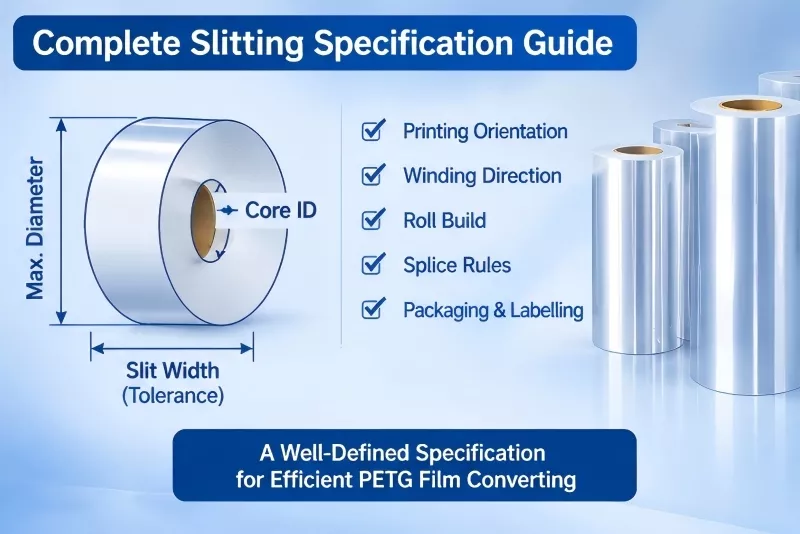
Slitting PETG Shrink Film Master Rolls: Winding Direction, Roll Build and Splice Specs
Learn how to specify PETG shrink film slitting, including winding direction, roll build, splice control, slit-roll dimensions, traceability and line qualification. -
.webp) Blog
Press Release Nov-21-2026
PETG Shrink Film Master Rolls: A Converter Specification and RFQ Guide
A converter can lose production time before the first sleeve reaches the filling line if a PETG master roll arrives with an unsuitable shrink curve, inconsistent gauge, poor winding, or incomplete technical documentation. PETG Shrink Film Master Rolls are not interchangeable simply because they share a polymer family. Film orientation, thickness, shrink force, shrink onset, surface treatment, and roll geometry all influence printing, seaming, slitting, sleeve forming, and final container fit.

contact
Tel: +86 17706217416
Add: Building L2A, No. 520, Lane 1588, Zhuguang Road, Hongqiao World Center, Qingpu District, Shanghai, China
follow us: